ModuleWorks announced the 2025.08 release of its software components for digital manufacturing and digital factory
ModuleWorks 2025.08 focuses on utilising integrated information, and this release comes with automated features to enhance process safety, toolpath generation efficiency, and part quality
SmartRoughing
Setting the correct parameters for roughing traditionally depends on the programmer's experience in balancing material removal, tool wear, and machine stability, resulting in possible conservative choices, extended cycle times, and inconsistent results.
SmartRoughing is a physics-driven toolpath algorithm that eliminates guesswork by utilising information on the machine's capabilities, tool geometry, and material properties. It can automatically generate toolpaths with constant engagement and optimised chip load.
This means programmers and machine shops can achieve faster machining, longer tool life and more consistent quality while making roughing processes accessible to less experienced users.
FeedControl
One of machining's toughest challenges is ensuring consistent chip formations, as variables such as heat, tool load, spindle deflection, and material hardening make the process both unpredictable and difficult to control.
ModuleWorks 2025.08 introduces FeedControl, a feed rate optimisation technology that can balance chip thickness, cutting forces, and spindle loads in real-time. FeedControl is designed to guarantee process stability, protect tools and deliver consistent results through its adaptation of machine-tool capabilities, tool geometry, and material behaviour.
Dynamic turning
During conventional turning, machining contours requires multiple tools, resulting in higher tooling costs and longer cycling times. Additionally, traditional turning does not accommodate toolpaths in the Y Z plane.
The new turning feature in ModuleWorks 2025.08, in combination with the FreeTurn tool, removes these limitations. Now, a single tool is able to machine all contours of a workpiece in one operation, while toolpaths are created directly in the Y Z plane. This reduces cycle time through fewer air cuts and tool changes, enabling faster feed rates for more efficient machining.
Deburring
In traditional workflows, deburring holes requires multiple passes with a spot drill, with no option to exclude smaller holes. At the same time, in three-axis setups, vertical edges cannot be filtered out, creating additional rework.
ModuleWorks 2025.08 has introduced a new deburring enhancement to address this issue. The enhancement enables filtering holes by diameter and excluding vertical edges directly within the toolpath calculation. Programmers gain more control, reducing redundant work and ensuring deburring strategies match the exact requirements of the cutting process.
Cutting simulation
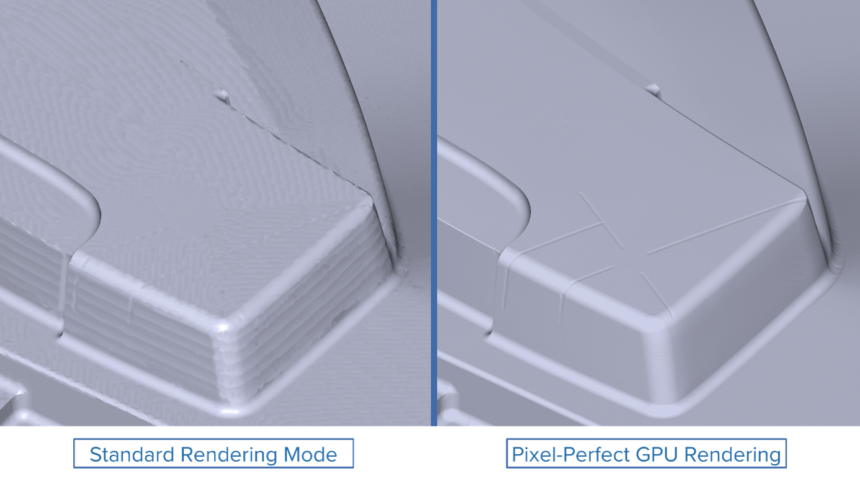
Standard rendering modes can often fall short in delivering the visual fidelity required for high-precision machining and fine-detail inspection. Part inspection and deviation analysis can be made difficult by inaccurate or blurry representations of the stock state.
A new GPU-accelerated rendering feature, introduced in ModuleWorks 2025.08, addresses this issue by enabling the creation of clearer visuals when the camera is idle.
The new feature provides machinists and inspectors with a detailed and accurate view of the current stock, making it easier to identify deviations and verify machining results.