Higher power density
Automotive power switching and control involves managing the distribution of electrical power to various vehicle subsystems, transitioning from traditional mechanical relays to advanced solid-state, intelligent, and zonal architectures
This evolution is driven by electrification, the need for enhanced diagnostics, and the demand for higher efficiency. The market for these technologies is rapidly growing, driven by the need for smarter interiors and the rise of electric vehicles (EVs) and automated driving systems.
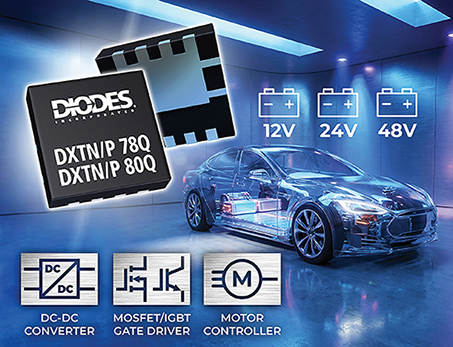
Diodes Incorporated has expanded its own automotive-compliant bipolar transistor portfolio with the introduction of the DXTN/P 78Q and 80Q series, targeting higher power density and efficiency in compact automotive electronic systems. Announced in December, the new NPN and PNP devices are designed to support increasingly demanding power switching and control requirements across modern vehicle architectures.
SHIFTING TO HIGHER VOLTAGE
The 12 new devices span a broad voltage range suitable for 12V, 24V and 48V automotive systems, reflecting the industry’s shift toward higher-voltage electrical platforms. Typical applications include gate driving for MOSFETs and IGBTs, power line and load switching, low-dropout voltage regulation, DC-DC conversion, and the control of motors, solenoids, relays and actuators. The devices are rated for continuous operation at temperatures up to 175°C and feature high electrostatic discharge robustness, with HBM ratings of 4kV and CDM ratings of 1kV, supporting reliable operation in harsh under-hood and power electronics environments.
A key feature of the DXTN/P 78Q and 80Q series is their ultra-low collector-emitter saturation voltage. With VCE(sat) as low as 17mV at 1A and on-state resistance down to 12mΩ, the devices significantly reduce conduction losses. Diodes Incorporated states that these characteristics enable designers to cut conduction losses by up to 50% compared with previous generations, contributing to lower heat generation and simplified thermal management in dense automotive designs.
PACKAGING MATTERS
Packaging also plays a central role in the new product family. The transistors are housed in the PowerDI3333-8 package, measuring just 3.3mm by 3.3mm. This represents up to a 75% reduction in PCB footprint compared with traditional SOT223 packages, freeing board space for additional circuitry or enabling further miniaturisation. Thermal performance is enhanced by a large underside heatsink, delivering an ultra-low junction-to-lead thermal resistance of 4.2°C/W. The inclusion of a side-wall plateable feature improves automated optical inspection visibility and strengthens solder joints, supporting high manufacturing quality and yield.
Both series offer breakdown voltage (BVCEO) ratings from 30V to 100V and robust current handling capability. The DXTN/P 80Q series is positioned for more demanding applications, with continuous current ratings up to 10 A and peak pulse capability of 20A, providing additional design margin for high-load conditions. Standard compliance versions are also offered for industrial and commercial applications, extending the reach of the technology beyond the automotive sector.