
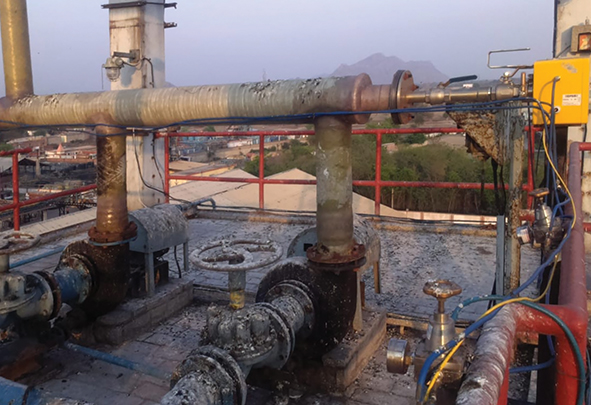
Bengt Löfstedt from Opsis discusses a solution for monitoring small concentrations of aggressive gases with low maintenance costs and high data availability
The operation of a chemical industry often comes with handling of dangerous and aggressive substances. Spills and leakages can have disastrous consequences not only to the operations but also to health and the environment.
Long-term exposure to relatively low levels of these substances can also have negative effects. There are therefore often legislation and emission limits in play, and there are usually regulations that mean limits must not be exceeded. An example is the monitoring of aggressive gases in the chlor-alkali industry which produces chlorine and other bulk chemicals.
The chlor-alkali process
The chlor-alkali process is a method for converting sodium chlorine (NaCl) into chloride gas (Cl2) and caustic soda (sodium hydroxide, NaOH). The process also generates hydrogen gas (H2).
In the process, an aqueous solution of NaCl is fed into one side of an electrolysis chamber where the anode splits the NaCl bond. Cl2 gas and Na+ ions are formed. In the other side of the chamber, fed by water only, the cathode splits the water whereby gaseous hydrogen and OH- ions are formed. The two sides are separated by a membrane which allows the Na+ ions to travel to the cathode side. There, they react with the OH- ions and form caustic soda. The Cl2 and H2 gases are caught on their respective sides of the membrane, while the NaOH solution is tapped on the cathode side.
Let us focus on the chlorine being produced. The gas must be cooled whereby gas-phase water residue also is condensed and removed from the gas mixture. Then compression and further cooling follow, producing liquid Cl2 which then can be stored and distributed.
There are also a variety of ways of managing and using the hydrogen generated, and the caustic soda is of course also utilised.
Emissions monitoring
In practice, the chlorine is not completely liquified in the cooling stages, and there may also occur gaseous impurities in the chlorine gas which are not condensed. This tail gas usually leads to a series of scrubbers catching and sometimes utilising the remaining gas. Nevertheless, at the end of the process, there is waste gas emitted to the ambient air, potentially containing a variety of pollutants such as gaseous Cl2 and HCl. These emissions may cause health and environmental concerns and it is therefore necessary to monitor the gas concentrations continuously.
Practical challenges and solutions
There are several ways of monitoring gases like Cl2 and HCl but there are a number of practical considerations. First, the gases themselves are aggressive even in low concentrations which excludes most sampling instrumentation. Second, the ambient environment at a chlor-alkali industry can be rather harsh, requiring very ruggedised equipment if an operator is to avoid too regular maintenance and replacement of equipment. At the same time, the emission limits can be low, calling for very precise monitoring solutions with low detection limits.
This leaves few options. One that has proven to be a very good solution is the Opsis fast-loop monitoring system. It operates with non-contact optical detection along a light path. To gain low-enough detection limits, a part of the flue gas is led with a relatively high flow via durable tubing to a monitoring cell which can be several metres long, enabling detection of the gases at very low concentrations. The gas is then returned to the duct, hence the name ‘fast loop’. To withstand the aggressive gases, the tubing and the cell is often manufactured in stainless steel or durable plastic.
It is only the measurement cell with its light emitter and receiver that is exposed to potentially tough ambient conditions. The light from the cell is led via an optical fibre to a shelter where the core instrumentation is located, analysing the spectrum of the light and calculating the sought-after gas concentrations.
Other monitoring applications
So far we have only discussed emissions monitoring, but these gas concentration measurement principles can also be used for process control applications. The concentration levels of interest might be much higher but both fast-loop monitoring systems and direct monitoring in gas ducts (‘in-situ’) can still be applied. With multi-gas analysers, the systems also become very cost-effective. Proven and durable monitoring systems keep maintenance efforts and operational disturbances at a minimum.
The open-path technology described in this article can also be applied to ambient air quality monitoring. In the context of chemical industries, so called fence-line monitoring is of particular interest. There are then monitoring light beams in the open air around the industry (‘along the fence’, hence the name), allowing quick detection of unintentional emissions irrespective of wind direction. Alarms can be raised for immediate attention to the situation, and data from the long-term monitoring can be used to assess the air quality in general and for studies on how to reduce the impact of the industry on the environment.
For more information visit: www.opsis.se