As EV manufacturers face increasing pressure to improve range while keeping vehicle costs competitive, there are several engineering challenges that those developing next-generation electric powertrains must overcome. And as Dr Martin Berger, vice president, Powertrain Systems (EDD) points out, there are also some real opportunities for efficiency gains
Summarising the current state of play, Berger says: “The key challenge for EV powertrains today is balancing three competing demands: range, cost and complexity. On the engineering side, that translates into a few fundamental hurdles, notably system efficiency versus cost – improving efficiency often requires more sophisticated components, but OEMs need solutions that scale economically.”
Berger flags thermal management as another hurdle: “The challenge here is in extracting maximum performance from batteries and e-drives without increasing energy consumption.”
Berger also notes that as architectures become more software-defined, integrating motors, inverters, controls and vehicle systems becomes considerably more demanding, meaning that integration complexity is another challenge. He adds: “And then there’s speed of innovation – customers expect shorter development cycles and faster rollout of new technologies. OEM development times mean suppliers have to perform at the same level or faster!”
Berger reveals that, for ZF, the biggest opportunity is in system-level optimisation rather than individual components. “That means highly integrated systems – bringing motor, inverter, software and thermal management together as one solution,” he explains.
“In terms of software and system intelligence, this means using control strategies to improve real-world efficiency and range. For thermal efficiency gains, we’re focusing on how technologies such as advanced thermal management can significantly extend EV range without the need for larger batteries. And when it comes to scalable platforms, we mean enabling OEMs to tailor solutions without reinventing architectures each time, which is crucial with lead times so much shorter,” Berger details.
The powertrain expert observes that ultimately, improving efficiency isn’t about a single breakthrough: “It’s about optimising the entire vehicle system to deliver more performance.”
STATE OF FLUX
ZF has played an important role in the evolution of electric driveline technology and Berger feels the organisation is well placed to continue this work in the coming years. “We expect that EV powertrains will evolve from largely hardware-driven systems to software-defined, fully integrated mobility platforms,” he states.
Berger says that three shifts will shape this transition. He explains: “The first is the move from components to integrated systems. Powertrains will no longer be developed as standalone components, but as fully connected systems working in harmony with chassis, software and vehicle controls.
“Electrification at scale, with flexibility is the next shift. The market will not move in a straight line. Our view is that OEMs need flexible architectures that support full electric, hybrid and transitional solutions depending on regional demand and use case,” he emphasises.
Software and AI as performance drivers is the third shift. “Software will increasingly determine efficiency, drivability and lifecycle performance,” comments Berger.
COMMERCIAL EDGE
Of course, ZF doesn’t only develop electric powertrains for passenger cars; its expertise spans commercial vehicles (CV) and off-highway machinery, too – applications whose requirements can vary quite considerably. Discussing the CV side, Dr.-Ing Andreas Grossl, vice president, Global Product-Segment Electric Driveline Solutions (TTE), notes: “It is important to recognise the complexity of the CV sector, which encompasses a wide range of applications, including buses, coaches and trucks. Each of these segments has distinct requirements in terms of operating speeds, vehicle weights and duty cycles, making the development of scalable solutions particularly challenging.”
Grossl also points out that due to the comparatively lower production volumes in the CV industry, “leveraging technological and manufacturing synergies becomes even more critical to achieving both innovation and cost efficiency.”
He says: “In our view, the real gamechanger is therefore not a single product, but our ability to create scalable and modular electrification solutions across these diverse applications.”

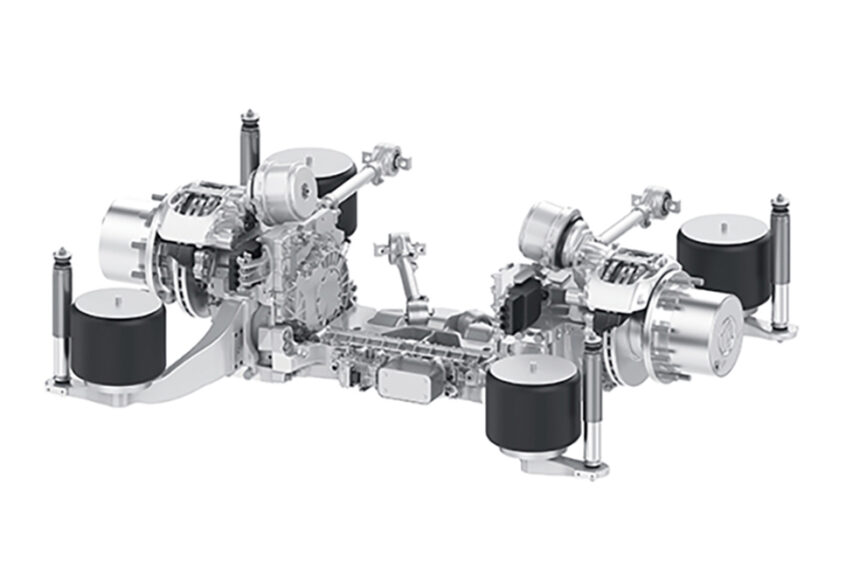
Citing examples of this approach, Grossl says: “In recent years we have introduced a modular e-drive platform that includes electric central drives and electric axles. By leveraging common technologies and architectures for key components such as e-motors or inverters, we enable OEMs to electrify both new and existing vehicle platforms with greater flexibility, scalability and cost efficiency.”
One fruit of this approach is ZF’s AxTrax 2 LF low-floor electric drive axle for city buses. “The second generation reaches Start of Production (SOP) in the next few months, and it demonstrates how advanced technologies originating from the passenger car sector can be successfully transferred to commercial vehicle applications,” says a proud Grossl.
He also cites the TraXon 2 Hybrid manual transmission as a significant development. “We see hybrid technology as an important enabler of the transition towards zero-emission transport, particularly as charging infrastructure continues to develop at different speeds across regions and applications. By leveraging key elements of our modular e-mobility architecture, TraXon 2 Hybrid provides a practical pathway to reduce emissions while maintaining operational flexibility and demonstrating the scalability of our technology approach,” Grossl details.
“Ultimately, what makes these developments truly game-changing is their ability to combine proven technologies with the specific requirements of the CV market, enabling highly efficient, reliable and competitive solutions across multiple vehicle segments,” Grossl observes.
A SELECT FEW
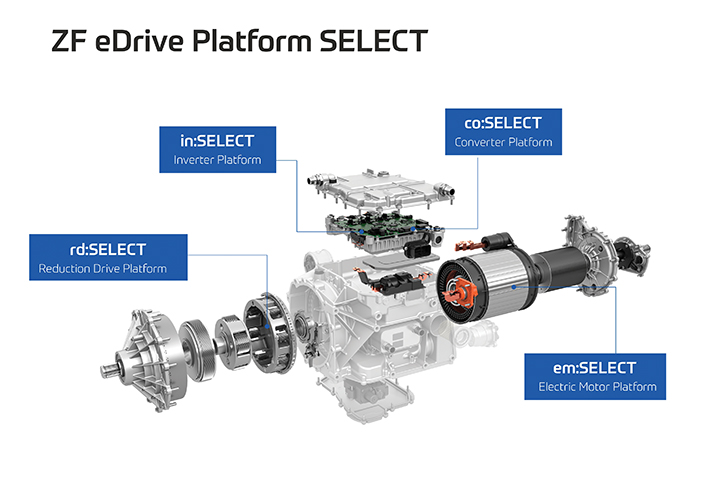
When Martin Berger is asked which of ZF’s numerous EV drivetrain launches he’s most proud of, he opts to highlight the company’s new SELECT e-drive platform. “What makes it particularly exciting is that it reflects a shift from component-based development to a system-first approach. Rather than optimising individual parts in isolation, SELECT combines electric motors, inverters, reduction gears and software within a modular platform that can be tailored to different vehicle requirements while maintaining high levels of efficiency and scalability,” Berger explains.
He says that the industry needs solutions that balance performance, efficiency, development speed and cost. “SELECT enables OEMs to access a broad range of electrified powertrain configurations from a common technology platform, reducing complexity while accelerating innovation. It is a great example of how ZF is helping customers navigate an increasingly diverse and fast-moving e-mobility market.”