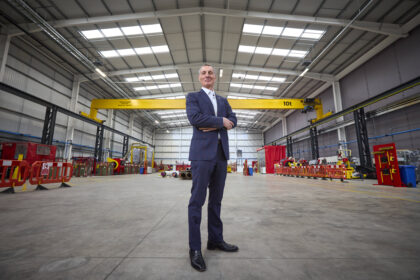
Littelfuse, an industrial technology manufacturing company, are recognising the sustained technical achievements of Dr Martin Schulz, global principal application engineer at Littelfuse
Schulz’s research has repeatedly challenged conventional assumptions in power semiconductor design. Schulz’s latest contribution, a direct liquid cooling technology for power modules, was developed and validated with Daimler Truck AG and can eliminate the ceramic isolation.
Schulz’s work spans five years of original, peer-reviewed research presented at PCIM, a power electronics conference. In recognition of this accomplishment, PCIM presented Schulz with a certificate of appreciation.
Schulz’s papers include reviving thyristor and gate-turn-off (GTO) technology for megawatt-scale charging infrastructure, testing whether silicon carbide is, and is not, the right material choice, and this year’s direct liquid cooling breakthrough.
Developed and validated with Daimler Truck AG and the Steinbeis Institute, the new direct cooling technology enables a power module to draw 800A oc continuous current from a chipset, classically rated for 600A, while having a thermal resistance junction-to-coolant under 0.08K/W.
When tested against a real 700km Mercedes-Benz GenH2 Truck mission profile, the approach reduced power losses by up to 15% and is projected to extend power-cycling lifetime by up to 800 times in comparison to classical, ceramic-isolated modules under identical conditions.
Schulz said, “Every one of these papers started with the same question: are we solving today’s power density and reliability challenges with yesterday’s assumptions? Removing the ceramic isolation layer and using the coolant itself as the isolation barrier is a good example; it is a simple idea on paper, but it took extensive testing to prove it could hold up in a real commercial vehicle drivetrain.”
Ash Golland, senior director, Technology and Systems Solutions, Littelfuse, said, “Being invited to present five years in a row at PCIM does not happen by accident; it happens because peers and reviewers keep finding value in the questions Martin is asking and the innovative, forward-thinking answers he provides. His work is a strong example of the kind of applied engineering leadership that helps our customers solve real power density and reliability challenges.”
Schulz’s published research, six papers presented over five years at PCIM, from 2022 through 2026, is available at https://engage.littelfuse.com/martin-schulz.