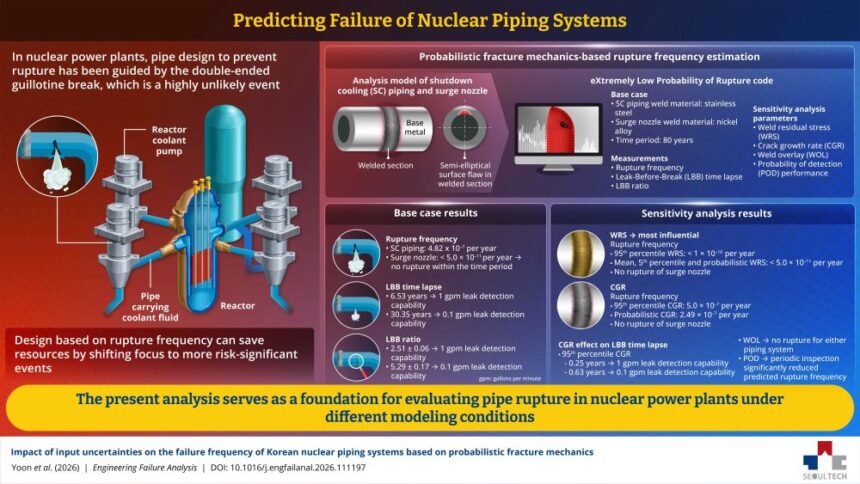
A study from Seoul National University of Science and Technology (SEOULTECH) evaluates how risk-based statistical modeling can predict cooling pipe safety in nuclear power plants, replacing worst-case assumptions with realistic data.
Traditional nuclear designs plan around extreme, highly unlikely worst-case scenarios—such as a cooling pipe snapping entirely in half. The research team used probabilistic modeling to track how real-world variables like welding stress, material wear, and routine safety inspections affect pipe health over an 80-year operational span.
Study details
Research question: How can risk-based analysis help engineers evaluate the actual likelihood of nuclear pipe breaks to improve plant safety and maintenance?
Key findings:
- Welding stress impact: Internal stress created during welding was the single biggest factor determining whether a pipe developed cracks over time.
- Inspections prevent major ruptures: Regular safety inspections drastically reduced pipe failure rates by several orders of magnitude, catching minor wear long before serious damage occurred.
What’s new here: Instead of relying on rigid, one-size-fits-all assumptions about pipe failure, this computer model incorporates real plant conditions—including wear over time and inspection quality—to help engineers focus safety resources on actual risks. This offers a clearer path to safely extend the life of aging nuclear plants and design more efficient new ones.
Lead researcher Professor Nam-Su Huh says, “A probabilistic framework can help engineers identify which factors govern the predicted failure behavior. In addition, rupture-frequency estimates can help distinguish extremely unlikely large breaks from more credible break sizes and provide a technical basis for treating them differently in plant design and safety evaluations.”
To read the fill paper click here.