Scratches, scuffs and punctures are facts of life for most drivers. But a new generation of self-healing materials could make everyday damage less of a problem, says Alex Harvey – senior associate and patent attorney at Withers & Rogers
Carmakers are already using self-healing materials in coatings, protective films and tyres. But how well do they work, and could they be used more widely in the future?
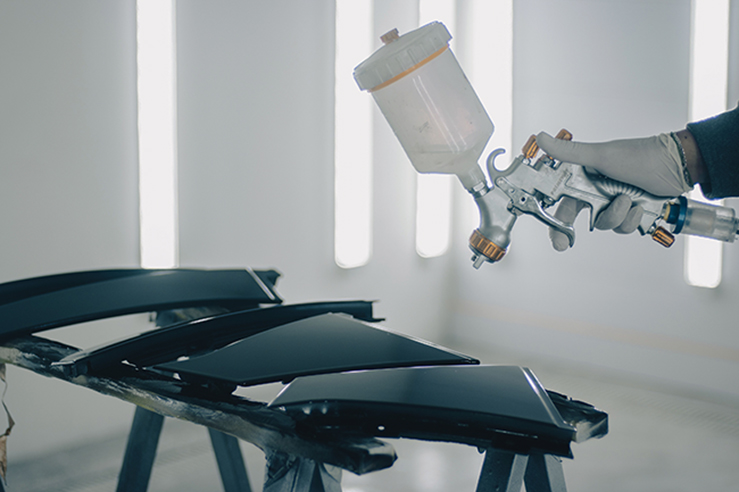
Self-healing paintwork is already appearing on some high-end models. These smart coatings are designed to deal with light damage, such as swirl marks from washing or minor scratches picked up in day-to-day use. Hyundai, for example, has recently filed a US patent application directed to a self-healing polyurethane coating film, and manufacturers such as Toyota and BMW have explored similar approaches.
The basic idea is straightforward; the coatings often contain shape-memory polymers that react to warmth from sunlight or hot water. As the material heats up, the polymer chains relax and become more mobile, which causes them to naturally return to their original form, thereby erasing any light scratches. These smart coatings are often described as having “intrinsic” self-healing properties, as they are built into the material itself.
Tyres take a slightly different, extrinsic approach. Notably, many self-healing tyres use a layer of sealant embedded inside the tread. If a nail or screw pierces the tyre, the sealant flows into the hole and forms an airtight plug. Whilst it won’t make the tyre as good as new, this repair can keep air loss under control long enough for the driver to reach a garage safely.
THE APPEAL IS NOT JUST AESTHETIC
A car that can shrug off minor scratches, keep its finish looking fresher for longer, or buy extra time after a puncture could be cheaper and less stressful to live with. For now, these materials are mainly about convenience, appearance and dealing with small-scale damage rather than fixing serious faults.
However, the technology underpinning many self-healing materials can also find use in safety-critical applications, particularly in the aerospace industry, where the ability to carry out in-flight repairs to aircraft and satellites can offer a vital safety net.
One eye-catching example developed by NASA in 2015 is a multi-layer ballistic polymer designed to help protect spacecraft from high-speed ballistic debris. The concept works in a similar way to a self-healing tyre. A viscous liquid monomer is sandwiched between a pair of solid polymer panels, ready to react when damage occurs. If a fast-moving projectile punctures the outer layer of the polymer, the liquid monomer flows into the breach and quickly solidifies upon contact with oxygen, plugging the hole before the damage can spread.
Another approach uses microscopic capsules hidden inside the material itself. For example, MPB Communications has been granted patent protection in the US (US8865798B2) for a self-healing composite for outer-space structures, in which the material matrix contains tiny capsules filled with a liquid healing agent. When a crack forms, the capsules rupture and release the healing agent into the damaged area, where it bonds with the surrounding matrix and helps repair the crack. In effect, the material carries its own first-aid kit.
European researchers are pushing the idea further with a smart composite called HealTech. Rather than simply reacting after damage occurs, the material is designed to sense cracks and then trigger a targeted repair using heat. Developed as part of the European Space Agency’s Project Cassandra, HealTech utilises a specialised carbon-fibre reinforced polymer with embedded internal sensors and 3D-printed aluminium heating grids. When damage is detected, the heating grids locally heat the affected area, which activates a healing agent provided inside the composite which can repair cracks or micro-fractures. Projects such as this provide a glimpse of a future in which critical structures can monitor their own health and carry out targeted repairs on damaged areas.
BRIGHT FUTURE
Whilst much R&D activity is at an early stage, it is evident that self-healing materials could find many different uses in the future. The intrinsic nature of many self-healing materials makes them ideally suited to autonomous cars, where they could be used to protect sensors and cameras from visual obstruction, ensuring safe and reliable operation. Self-healing composites could also be used to extend the life of damage-prone wind turbines.
With so much innovation activity underway and so much still to learn about the capabilities of self-healing materials, it’s recommended for innovators to seek advice about intellectual property (IP) protection at an early stage. Research-led initiatives often involve some degree of collaboration, and it is just as important to ensure pre-existing IP is protected, as it is to secure a stake in any new IP created together.
Read the October issue of International Design Engineer magazine here, or visit our magazine archive for all our recent publications.