Digital twins are changing the way mines, underground structures and drilling operations can be planned, monitored and maintained.
However, there is a fundamental difference between a digital model and a digital twin: The latter needs to know what is happening in the physical world. That is where precise sensor data becomes critical.
Going underground
Building Information Modelling (BIM) has long moved beyond its origins in building design. The principle of creating a detailed digital representation of a physical asset also has considerable potential in mining and underground engineering, where operators manage complex networks of shafts, tunnels, caverns, access routes and technical installations – often under demanding and continuously changing conditions.
This is where ASC inertial sensor technology comes into play: precise accelerometers that make these changing conditions and their impact on underground structures as well as machinery and equipment visible.
BIM can bring geological, structural and engineering information together within a common digital environment. During planning and construction, this helps engineers understand spatial relationships, coordinate infrastructure and identify potential conflicts. But once excavation, mining or drilling begins, another question becomes paramount: How is the real structure or machine behaving?
This is where the transition from BIM model to digital twin takes place.
Feeding the digital twin real-world data
By integrating measurement data from the physical asset, a digital twin can continuously compare expected and actual behaviour. In a mining environment, acceleration and vibration data can, for example, contribute to monitoring machinery and equipment or provide information about dynamic loads affecting structures and installations.
Applications range from monitoring crushers, conveyors, drilling equipment and other machinery to tracking vibrations in underground infrastructure. Sensor data helps reveal changing vibration patterns or unusual dynamic behaviour that may warrant closer investigation. Combined with other monitoring information, these measurements support condition-based and predictive maintenance strategies – typically allowing intervention before deterioration results in unplanned downtime, or worse.
The same principle applies to underground structures. Measurements taken at selected points in tunnels, shafts or other excavations provide additional real-world information to improve structural health monitoring. Rather than relying solely on periodic inspection or a static engineering model, operators can progressively enrich their digital representation with measured behaviour.
ASC ECO series
Capacitive MEMS-based ASC ECO accelerometers provide uni-, bi- or triaxial measurement, allowing the sensor configuration to be matched to the task at hand. All models are available with measurement ranges from ±2g to ±40g and a noise density from 22.5 to 90µg/√Hz.
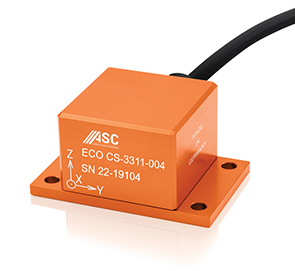
Their ability to measure from DC, including very low-frequency acceleration, makes capacitive technology particularly suitable where both slow structural movement and dynamic vibration phenomena need to be captured. ASC ECO sensors provide a differential analogue voltage output and come in a lightweight aluminium housing. Their IP68 protection and shock resistance of up to 10,000g are particularly relevant for installations exposed to dust, moisture and mechanical loads.
For applications requiring longer transmission distances, ASC ECO CS sensors offer a 4–20mA current output. They are used in applications involving cable lengths exceeding 100m or requiring high EMC immunity.
Power of prediction
The true potential of digital twins in mining, therefore, is not simply better visualisation; it is the connection and integration of virtual representation with continuously acquired real-world data from the actual worksite.
As mining operations become more connected and data-driven, this feedback loop enables engineers to identify changes, validate models and make maintenance decisions based on current asset conditions and behaviour.
BIM provides a digital framework. Sensors provide physical reality. Bringing the two together turns a virtual model of the mine into far more value for its operator.
For more information visit: www.asc-sensors.de