For mining companies looking to electrify their operations to increase productivity and reduce exposure to diesel, selecting the right battery technology is a key consideration. In making their selection, the technology must deliver the power, charging performance, reliability, and lifetime required to operate continuously in some of the world’s most demanding environments to ultimately improve the mine’s $/ton.
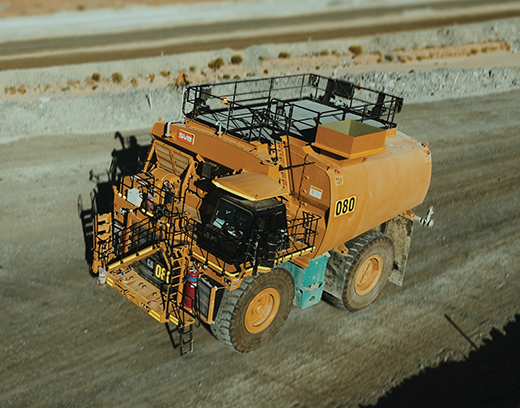
Equating battery performance into mine performance is a challenge that has been put to the test in Western Australia’s Pilbara region. Since June 2026, in conjunction with partners HD Hybrids, a subsidiary of Switch Technologies and its mine partner and global lithium producer PLS Group Limited (PLS), a hybrid CAT 785 water cart has been undergoing mine site trials using a battery system powered by Echion’s proprietary niobium-based XNO anode material.
The truck, nicknamed Trish after Tricia the elephant from Perth Zoo, is the first of its kind and is the result of several rapid stages of development. The CAT 785 truck was retrofitted by HD Hybrids with a 1MW-capable battery system comprising three XNO powered sub packs. The system supports safe continuous fast charging and discharging at 10C without generating excess heat, has a projected life cycle exceeding 50,000 cycles. It enables effective regenerative charging during braking, including on declines and a significant power boost on inclines.
For water carts, maintaining speed on grade is important to not impact the productivity of the mine. During the Pilbara mining trials, Trish was repeatedly driven up and down a steep section of a waste dump with conditions described by the team as a more intensive battery duty cycle than a typical mining haul cycle. Even under these conditions, the system performed without producing excess heat generation due to its high efficiency design, which starts from the battery chemistry level with XNO.
The results and implications
Early operational results indicated that the hybrid system could improve productivity and thus financial performance of the mine. The water cart travelled uphill under load at around twice the speed of its diesel counterpart, while drivers reported noticeably greater power, strong handling, and reduced noise. For operators, this performance difference could benefit the wider fleet. A fully loaded truck that climbs more quickly can complete its operating cycle in less time, potentially increasing utilisation, reducing the number of movements required to complete the workload or potentially reducing fleet size. Overall, the early trial data indicate that the hybrid system could reduce annual fuel consumption by more than 15%, compared to conventional CAT 785 water trucks operating under comparable conditions and consuming over 500,000l of diesel a year.
The battery system and modified fuel tank of the hybrid retrofit kit occupies approximately the same volume in the truck chassis as a standard long range fuel tank. This non-invasive modification encourages operators to retrofit existing equipment rather than replace entire fleets, creating a quicker route to electrification and allowing the technology to be introduced progressively.
For Echion, Trish is an example where the XNO battery chemistry is operating in a heavy-duty vehicle at an active mine. The truck is generating evidence that can support miners in making their battery technology selection for mining vehicle electrification.
For more information visit: www.echiontech.com