In June 2026, the UK Government revealed it was investing over £5 billion in military drone technology over four years, followed by plans for up to £400 million of investment in long-endurance surveillance drones and more than 1,000 smaller unmanned aircraft announced in September 2026
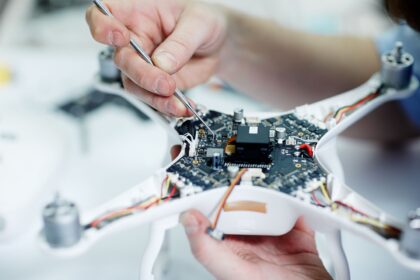
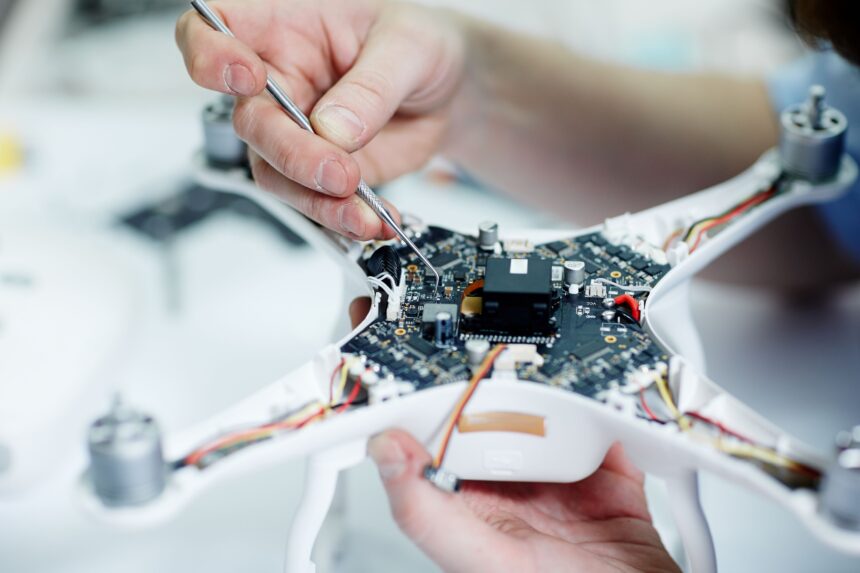
Drones are becoming more sophisticated; they need to process vast amounts of information, accommodate advanced payloads, and operate reliably in environments where maintenance or intervention may not be straightforward.
For manufacturers, this creates a balancing act as components must deliver the required performance without adding unnecessary weight, consuming too much power, or compromising reliability. To get this balance right, manufacturers need to understand how the different electronic systems work together.
Powering more capable aircraft
Electric motors, electronic speed controllers (ESCs) and battery management systems must work together to deliver consistent performance while making the best possible use of available battery capacity.
Within this process, MOSFETs control current flow, and their characteristics influence how efficiently power is converted. In particular, on-resistance (RDA(on)), which describes the resistance between the drain and source when a MOSFET is conducting, affects conduction losses, while switching behaviour contributes to other power losses.
Reducing conduction losses can limit heat generation and enhance efficiency. However, selecting a MOSFET is not just about choosing the lowest possible on-resistance, as gate charge, switching frequency, operating current, and temperature also affect performance.
Research by Deboy et al. (2000), published in the Proceedings of the Bipolar/BiCMOS Circuits and Technology Meeting, examined the trade-off between conduction and switching losses in power semiconductor devices. In one comparison, the researchers found that a 600V CooIMOS device reduced turn-off losses by 50% compared with conventional Double-Diffused Metal-Oxide-Semiconductor (DMOS) technology, demonstrating how switching characteristics can influence overall power efficiency.
APM Power Microelectronics’ product portfolio includes dual N-channel half-bridge MOSFETs identified for brushless DC motor applications, illustrating the type of integrated power devices that can be considered for motor control.
MicroDiode Semiconductor also identifies low-voltage, high-current MOSFETs as relevant to ESCs, motor control, and battery management. Their suitability is dependent on the electrical and thermal requirements of the particular design.
That thermal aspect is important as drones have limited space for cooling solutions, so heat generated by power electronics needs to be considered alongside the physical layout of the board, the available printed circuit board (PCB) copper area and the way components are mounted. A device that performs well electrically still needs to operate within its thermal limits.
Why capacitors matter in flight
Capacitors help keep drones’ electronic systems stable. They smooth voltage supplies, help manage transient changes in voltage and current, and reduce electrical noise that could affect sensitive equipment.
This matters for ESCs and other power-conversion circuits, where capacitors can be exposed to significant ripple current. As current passes through a capacitor’s equivalent series resistance (ESR), it generates heat. If this heat is not managed, it can reduce the component’s operating life.
For example, Hongda Capacitors’ HTHC2 hybrid tantalum range is designed for high-ripple-current applications, with low-ESR options and high capacitance values. Its HCA39 hermetically sealed tantalum range offers another construction for applications where environmental protection and thermal cycling are concerns.
Capacitors also have a role in communications and RF equipment. Power-rail requirements differ from those of a radar or radio-frequency circuit, so designers must consider operating frequency, capacitance, ESR, and physical construction rather than treating all capacitors as interchangeable.
Capacitance and voltage ratings alone do not tell the whole story. Ripple current, temperature, and operating conditions all need to be considered.
Keeping everything connected
A drone brings together multiple electronic systems, including cameras, sensors, navigation equipment, and communications technology, that all need to work together, making the connectors and cable assemblies joining them critical to the design.
Connections must carry power and data reliably while handling vibration, shock, and exposure to the elements. Designers must also consider weight, physical dimensions, and electromagnetic compatibility (EMC), particularly where several electronic systems operate close together.
For example, a drone carrying external cameras or sensors might require connectors with suitable environmental protection. LinkHive Connectors’ catalogue distinguishes between its B-series indoor connectors and K-series outdoor connectors. The latter are listed with IP66/IP68 protection, while the B-series is rated IP50. These ratings indicate protection against dust and water ingress; they do not, by themselves, establish suitability for a particular vibration or shock environment.
Custom cable assemblies introduce another consideration. Cable length, shielding, connector configuration, and wiring arrangements must suit the equipment being connected. Getting this right can help avoid unnecessary weight and integration problems.
Another question is how the different electronic systems exchange information. Controller Area Network (CAN) is a communication protocol that enables multiple electronic control units to share information over a network rather than relying on separate point-to-point connections.
A CAN interface includes a controller and a transceiver. The controller handles the communication protocol, while the transceiver provides the electrical interface to the bus.
An example controller is Xinluda’s XL2512, which supports CAN 2.0B communication at up to 1 Mbps and interfaces with a microcontroller through SPI. This shows the technology available for connecting electronic control systems, though suitability for a particular unmanned aerial vehicle (UAV) depends on its architecture and qualification requirements.
Different drones, different requirements
Not every drone has the same operating requirements. A lightweight commercial inspection aircraft has different priorities than a heavy-lift industrial platform or a high-altitude military UAV.
That is why component selection needs to start with an understanding of how the aircraft will be used. How much power does it require? What temperatures will it encounter? Will it be exposed to significant vibration, electrical noise or moisture? What sensors and other equipment will it carry?
These questions are critical because a component that works in one application may not suit another. For example, a connector’s ingress protection rating does not automatically demonstrate that it can withstand the vibration of a particular aircraft. Additionally, a capacitor’s voltage rating does not establish whether it can handle the ripple current or temperature of its intended circuit.
Manufacturers also need to consider how they will assess and qualify components. Early testing can help identify problems before they become embedded in a design, when changing a part may require wider validation.
The market is also expanding beyond defence. In May 2026, the Government announced a £46.5 million funding package intended to support drone and advanced air mobility development, alongside work on a drone identification system. As applications develop across areas such as infrastructure inspection, deliveries and emergency services, manufacturers will need to account for a varied range of operating conditions.
The challenge isn’t fitting more technology into a smaller aircraft; it’s ensuring every part of the electronic system works reliably with the others, within the limits of the aircraft’s weight, power, and operating environment. As UAV capabilities develop, careful component selection and system-level testing are central to making those designs work.
Contributed by James Tyler, operations director at electronic components distributor Avant Electronics