
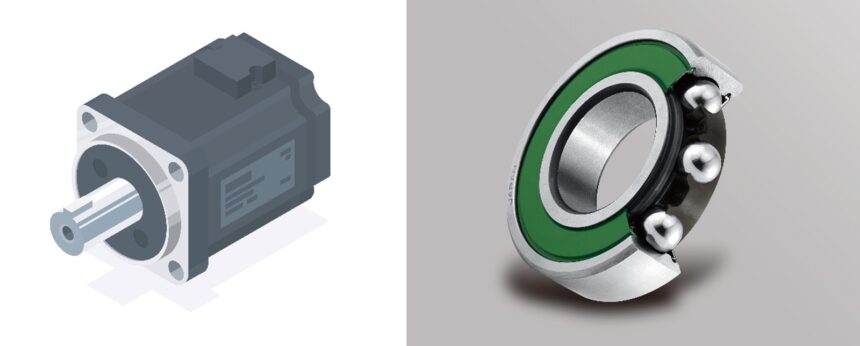
Grease and oil particles are reduced by new low-particle-emission bearing for servomotors
NSK’s new low-particle-emission bearing for servomotors will reduce the amount of grease and oil particle emissions. This comes after NSK undertook research into the industry-wide issue, which can affect applications such as robots. An entirely new bearing structure has been designed for this development which has advanced design elements. The company used high-precision test machinery which replicated a real servomotor to ensure its ability.
NSK claims its new bearing offers twice the low-particle-emission performance of other conventional products, due to its new grease and seal technology. The rubber seal delivers lower torque whilst the grease can double the lifespan. NSK attributes this development to its extensive experience in tribology. Tribology is the practice of controlling friction and wear using lubricants and materials surfaces.
The need for robots is growing year after year, with countries' labour pools shortening. Robot reliability is dependent on its major components and without this reliability, robots can never transition from manual to automated processes.
A servomotor holds two bearings, one being a load-side bearing supporting the shaft where it exits the servomotor and the other a counter load-side bearing, located between the encoder disc and the brake disc. A typical arm robot may feature up to six servomotors to facilitate robot positioning and speed of its various axes.
Servomotors operate in high-temperature environments, which can cause bearings to scatter tiny particles of grease and oil as they rotate. This can cause brake slippages and encoder error reads as the oil and grease stick to the disks. NSK looks to remedy this issue using its newly developed anti-scatter grease and seals that give a high level of hermeticity.
NSK’s new grease uses superior thermally resistant components to ensure low particle emissions whilst also giving better resistance to seizing. This restrains evaporation. The new rubber seal facilitates 10% less torque and reduces particle emission, thanks to its redesigned lip shape.