The challenges of accurate surface temperature measurement will vary depending on whether it is the temperature of a liquid, gas or process medium that is being measured
In many industrial applications, permanently modifying pipework, vessels or machinery to accommodate a sensor may be unnecessary or impractical, particularly when measurements are required temporarily or at several different locations.
Thermocouples are widely used throughout industry, but conventional sheathed assemblies are primarily designed for tip sensing. When applied directly to a surface, the physical construction of a probe can make good thermal contact difficult, while heat conduction along the probe stem can contribute to measurement errors.
For reliable surface measurement, the sensing junction needs to make effective and repeatable contact with the surface being monitored. Several attachment methods can achieve this, including adhesive patches, washer and stud arrangements, pipe clips and magnetic mounting.
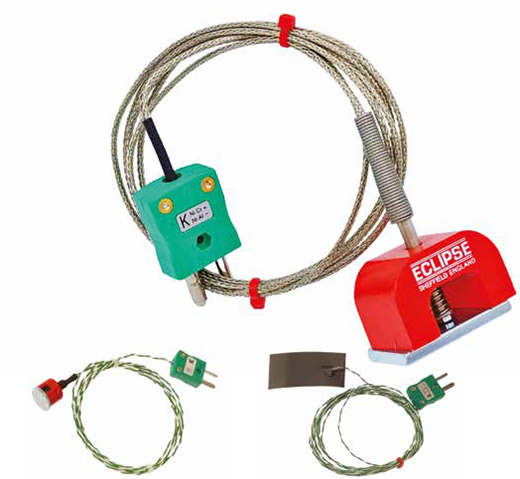
For ferrous surfaces, magnetic thermocouples provide an alternative that does not require drilling, welding or permanent mechanical fixing. The sensor can be positioned directly on the measurement point and subsequently removed or relocated. This can be particularly useful during equipment commissioning, maintenance, testing and fault-finding, where engineers may need to compare temperatures at several locations.
MAGNETIC THERMOCOUPLE CONFIGURATIONS
UK temperature sensor manufacturer Labfacility has developed magnetic thermocouple configurations with pull strengths ranging from 0.7kg to 11.8kg, providing different attachment options according to the requirements of the application.
Lower pull strengths can be suitable for lightweight assemblies and accessible measurement positions. Greater holding forces may be required where cable weight, movement, orientation or vibration places additional load on the sensor. Button-style and higher-pull magnet constructions can therefore address different installation requirements, while flexible magnetic-strip designs provide another option where a larger contact area is advantageous.
Pull strength alone, however, does not determine measurement performance. Surface condition is an important consideration. Paint, coatings, corrosion, contamination and surface geometry can influence both magnetic adhesion and thermal contact.
The sensor should be positioned on a clean, suitable ferrous surface with consideration given to both mechanical security and thermal contact.
Sensor construction must also reflect the surrounding environment. Cable insulation such as PTFE or PFA can be selected according to operating conditions, while stainless-steel overbraid can provide additional mechanical protection where required. The operating limits of the magnet itself must also be considered alongside those of the thermocouple and cable.
Magnetic thermocouples will not replace permanently installed sensors where continuous process measurement or control is required. They do, however, provide engineers with a practical method of obtaining temporary or repositionable surface temperature measurements without permanently altering the equipment being monitored.
For more information, visit: www.labfacility.com