improves the efficiency of their extraction and processing. With the buoyant oil market and high values of hydrocarbon liquidsthe prediction of sales volumes is increasingly important. As gas condensate fields mature and the number of satellite fields feeding into a platform growsso does the complexity of predicting the commingled export liquid rates.”Predicting the properties of oil and gas, under various conditions, improves the efficiency of their…
Liquid allocation is also important where different partner interests exist. Allocation based on the test separator condensate:gas ratio (CGR) is problematic because test-separator rates are very different from export rates. Welltest CGRs may also become inaccurate as the liquid rates decline.
Predictions of Gas Condensate field performance are further complicated when producing below the reservoir dewpoint and deeper into the two phase region. Wellstream compositions can be calculated using fully compositional simulators but these are slow and complicated to run so most fields use faster black oil models.
History matched gas condensate rates using standard Black Oil models generally give good predictions of reservoir pressures and export gas volumes but poorer predictions of export liquid rates.
UnfortunatelyBlack Oil tables can only be generated for constant processing conditions in simple configurations. This can lead to substantial errorsespecially later in field life when wellhead pressures are much lower than originally modelled. It is not possiblewithin many reservoir simulatorsto change the processing conditions in the Black Oil tables part way through a run.
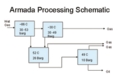
A novel solution to the problem of predicting condensate production is presented using the multi-field North Sea Armada hub as a case study. The bottomhole pressures from the history matched model were used to determine the well CGRs over several years. Wellstream compositions for each Armada well were calculated using OilVLea software application developed by Advantica in partnership with Petrophase Limitedwhich embeds equations of state in the spreadsheet. The flexibility of this method allows any complex of interlinked separators to be modelled. It was also possible to reflect changes in processing facilities and separator conditions. The method effectively gives a compositional output from a black oil model. The results matched the fiscal meter liquid export rates to 0.1percent by mass when summed over several years’ production.
Daily fluctuations were up to 5percentmuch of which was noise. There was no need for tuning or regression; the authors believe this to be a world first on mixed condensate systems. The accurate predictions on a well by well basis also lead to a dramatic improvement in liquids allocation.
The method can also be applied in predictive mode for future liquid production and accommodate changing processing conditions. It gives greater accuracy of liquid rates of a compositional model while retaining the advantages of full field simulation accuracy over a tank model.o
Enter 70 or at www.engineerlive.com/iog
Brian Moffatt is with Advantica LtdLoughboroughLeicestershireUK. www.advanticagroup.com/oilvle
“