The expanded partnership will bring AI into the real world
Siemens has launched its Digital Twin Composer, a new software solution that builds on Industrial Metaverse environments at scale, and has expanded its strategic partnership with Nvidia to bring AI into the real world
Digital Twin Composer
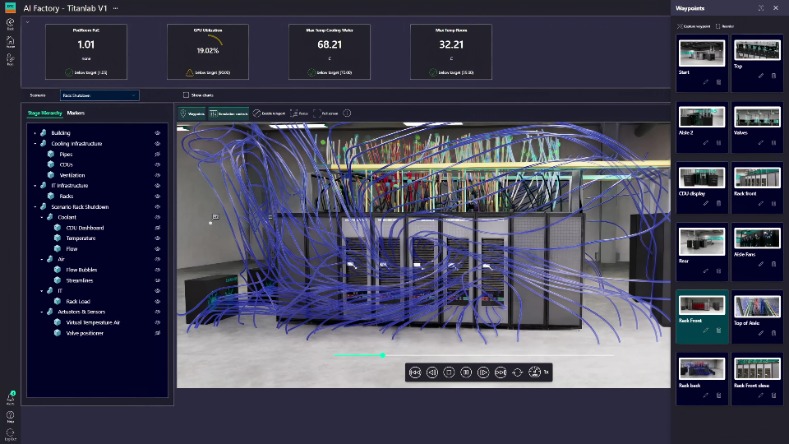
The Digital Twin Composer lets industrial companies combine 2D and 3D digital twin data from Siemens with real-time physical information in a managed, secure, photorealistic visual scene, built with Nvidia Omniverse libraries.
With Digital Twin Composer, companies can build and maintain a global environment that contains all aspects of their product or production data in a secure, managed, high-fidelity 3D experience throughout the lifecycle of the product, process, or facility.
Digital Twin Composer provides contextualised, real-time insights and intelligence, allowing companies to visualise, interact with, and iterate on any product, process, or factory in its real-world context before physical design or construction.
PepsiCo and Siemens are digitally transforming select US manufacturing and warehouse facilities by converting them into high-fidelity 3D digital twins that simulate plant operation and the end-to-end supply chain to establish a performance baseline.
Teams optimised and validated new configurations to increase capacity and throughput, giving PepsiCo a unified, real-time view of operations with the flexibility to integrate AI-driven capabilities over time.
Using Siemens’ Digital Twin Composer, Nvidia Omniverse, and computer vision, PepsiCo can recreate every machine, conveyor, pallet route, and operator path with greater accuracy. This allows AI agents to simulate, test, and refine system changes, identifying up to 90% of potential issues before any physical modifications.
Joe Bohman, executive vice president, PLM Products, Siemens Digital Industries Software, said, “The new Digital Twin Composer delivers on our vision for the industrial metaverse. It helps manufacturers to overcome the unprecedented challenges of mastering complexity, accelerating production, reducing costs and increasing profitability. Siemens and Nvidia are partnering to help manufacturers bring the most complex products, processes and factories online faster, boost resiliency and sustainability, and continuously optimise performance.”
Rev Lebaredian, vice president of Omniverse and Simulation Technology, Nvidia, said, "In an era where every physical object and process will have a digital twin, Siemens' Digital Twin Composer establishes a digital thread that connects the silos of design, engineering, and operations across the Siemens Xcelerator ecosystem. By integrating Nvidia Omniverse libraries into Digital Twin Composer, enterprises can take advantage of physically accurate simulation across their workflows to validate their entire lifecycle – from product design to factory logistics, in the virtual world before committing a single atom to the real one.”
Expanding partnership
The expansion of Siemens and Nvidia’s partnership to bring AI into the real world will have Nvidia provide the AI infrastructure, simulation libraries, models, frameworks, and blueprints, while Siemens will commit hundreds of industrial AI experts and hardware and software.
Roland Busch, president and CEO of Siemens AG, said, “Together, we are building the Industrial AI operating system, redefining how the physical world is designed, built, and run, to scale AI and create real-world impact. By combining Nvidia’s leadership in accelerated computing and AI platforms with Siemens’ leading hardware, software, industrial AI and data, we’re empowering customers to develop products faster with the most comprehensive digital twins, adapt production in real time, and accelerate technologies from chips to AI factories.”
Jenson Huang, founder and CEO of Nvidia, said, “Generative AI and accelerated computing have ignited a new industrial revolution, transforming digital twins from passive simulations into the active intelligence of the physical world. Our partnership with Siemens fuses the world's leading industrial software with NVIDIA's full-stack AI platform to close the gap between ideas and reality, empowering industries to simulate complex systems in software, then seamlessly automate and operate them in the physical world.”
The two companies will build AI-accelerated industrial solutions across the entire lifecycle of products and production, promoting faster innovation, continuous optimisation, and more resilient, sustainable manufacturing. The two plan to build the world’s first fully AI-driven, adaptive manufacturing sites globally, starting with the Siemens Electronics Factory in Erlangen, Germany.
An ‘AI Brain’ operated by software-defined automation and industrial operations software, combined with Nvidia Omniverse libraries and Nvidia AI infrastructure, can continuously analyse digital twins, virtually test improvements, and turn validated insights into operational changes on the shop floor. This enables faster, more reliable decision-making from design to deployment, increasing productivity and reducing commissioning time and risk.
The partnership expansion will have Siemens complete GPU acceleration across its simulation portfolio and expand support for Nvidia CUDA-X libraries and AI physics models, allowing customers to run larger, more accurate simulations faster. Building on that, the companies will advance toward generative simulation by using Nvidia PhysicsNeMo and open-source models to deliver autonomous digital twins for real-time engineering design and autonomous optimisation.
Siemens and Nvidia aim to accelerate the AI revolution by applying industrial AI operating logic to semiconductors and AI factories. Starting with semiconductor design and building on Nvidia’s use of Siemens’ tools, Siemens will integrate Nvidia CUDA-X libraries, PhysicsNeMo, and GPU acceleration across its EDA portfolio, focusing on verification, layout, and process optimisation to target 2-10x speed-ups in workflows.
The partnership will add AI-assisted capabilities, including layout guidance, debug support, and circuit optimisation, to advance engineering productivity while meeting manufacturing requirements. These capabilities will enhance AI-native engines for design, verification, manufacturability, and digital twin approaches, minimising design cycles, improving yield, and providing more reliable outcomes.
Siemens and Nvidia will also develop a repeatable blueprint for next-generation AI factories, accelerating the AI revolution and providing a foundation for their AI-accelerated industrial portfolios.
The blueprint will balance next-generation high-density computing demands for power, cooling, and automation while ensuring technologies are positioned for speed and efficiency, optimising the entire lifecycle.