
As autonomous driving systems become increasingly reliant on AI, the challenge facing vehicle manufacturers is shifting from collecting data to managing it effectively
Modern development programmes generate enormous volumes of sensor information from both physical testing and simulation, yet transforming that raw data into meaningful validation and AI training remains one of the industry’s biggest engineering challenges.
Foretellix has developed a platform designed to automate this process, enabling OEMs to organise, analyse, generate and validate training data while accelerating autonomous vehicle development cycles. Izhar Melnikovsky, application engineer at Foretellix, says the transition from traditional rule-based software to AI-driven vehicle systems is fundamentally changing how validation is performed: “The market is going through an AI revolution. The main transition is from a rule-based approach to an AI end-to-end approach, or even a modular approach with AI-driven components. A lot of this development needs to go through training and validation.”
MAKING DATA SMARTER
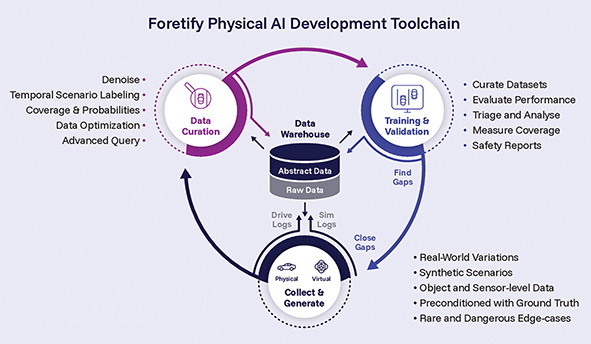
According to Melnikovsky, conventional development workflows struggle to support the rapid iteration demanded by AI-based autonomous driving systems. Rather than simply increasing the volume of testing, Foretellix focuses on making data itself more intelligent by automating its organisation, interpretation and reuse. He says, “The toolchain that we have developed is focused around working with these companies, and it’s all about making the most out of the data, so automating the data, making the most out of abstraction of the data, and understanding where the gap is.”
The process begins with large-scale collection of object-level data from development fleets. Although modern vehicles continuously generate trajectories, object detections and sensor outputs, these datasets alone provide little engineering value without additional context. To solve this, Foretellix has developed what it describes as Temporal Scenario Labelling (TSL). Rather than viewing vehicles simply as moving objects with speed and direction vectors, the platform automatically classifies driving behaviour into meaningful scenarios.
By transforming raw sensor data into structured driving events, engineers can search datasets using real-world driving situations rather than individual sensor parameters. This enables development teams to rapidly identify highly specific scenarios for AI training or software validation. For example, engineers developing perception algorithms for unprotected left turns can query only those relevant driving events instead of manually reviewing thousands of kilometres of recorded data.
“We’re strong believers in measuring ourselves with coverage, rather than traditionally counting miles,” says Melnikovsky. This approach allows engineers to identify gaps within their Operational Design Domain (ODD), particularly the rare edge cases that are unlikely to be encountered during conventional road testing. These so-called long-tail scenarios remain among the greatest obstacles to autonomous vehicle validation.
“Think of the child crossing the street in the snow at night,” Melnikovsky explains. “This is something you wouldn’t encounter in a real-world testing environment. This can be achieved with simulation.”
A TWO-PRONGED APPROACH
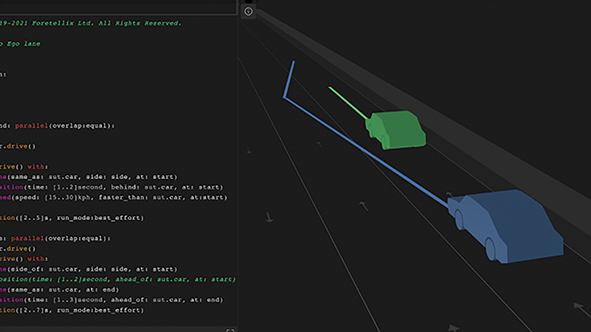
Foretellix addresses this through two complementary simulation strategies. One generates variations from recorded real-world driving data by modifying the behaviour of surrounding traffic. The other creates entirely synthetic scenarios using a constraint-based scenario generation engine.
Rather than exhaustively sweeping every possible parameter combination, the platform uses explicit engineering constraints combined with implicit behavioural relationships to generate only physically meaningful scenarios. This allows manufacturers to explore hundreds of thousands of variations while avoiding unrealistic test cases that add little validation value.
The company also places significant emphasis on ensuring AI-generated simulation remains physically credible. As generative AI increasingly becomes part of simulation workflows, Foretellix uses object-level data as a grounding mechanism to prevent world models from creating implausible environments.
“Without some grounding factor, without an anchor, these solutions tend to hallucinate,” Melnikovsky says. “Having a bounding box object with a physically accurate base leads to a much more realistic output.”
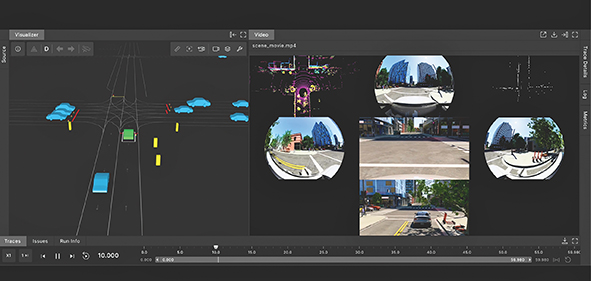
The grounded object-level simulation can then be rendered into high-fidelity sensor outputs using AI world models, producing realistic camera and lidar datasets suitable for perception training without compromising physical accuracy.
Artificial intelligence also supports data analytics throughout the platform. Rather than requiring engineers to manually search for performance trends, Foretellix’s assistant can identify correlations between environmental conditions and autonomous system performance.
Melnikovsky notes that the system can reveal issues engineers may not initially consider, identifying factors such as road curvature or lighting conditions that contribute disproportionately to collisions or perception errors. Equally important is the platform’s automated data curation capability. Real-world datasets often contain missing frames, inconsistent object tracking and sensor noise that complicate downstream analysis.
“We’ve created a very delicate algorithm to clean out the data without compromising any of the important frames,” Melnikovsky explains.
For manufacturers developing increasingly AI-centric vehicle architectures, reducing engineering effort around data preparation may prove just as valuable as improving simulation itself.
Summarising the company’s philosophy, Melnikovsky adds: “We carry out a lot of automation in order to allow the engineers to focus on where it matters, rather than collecting the data and filtering it and finding the relevant subset.”
As autonomous vehicle programmes continue to generate exponentially larger datasets, technologies that automate scenario identification, validation coverage and AI training data generation are becoming essential components of the development process. Foretellix’s platform demonstrates how intelligent data management can help manufacturers shorten development cycles while improving confidence in the safety and robustness of next-generation autonomous driving systems.