Hear from a simulation specialist on how this approach delivers the freedom that allows engineers to push boundaries
As automotive OEMs turn to virtual solutions to speed up their development work, a simulation specialist explains to Louise Davis how this approach delivers the freedom that allows engineers to push boundaries
For automotive manufacturers, the benefits of simulation over real-world testing are multi-faceted, believes Ian Haigh, solutions manager at Ansible Motion. “OEMs are under growing pressure to develop their increasingly complex vehicles more quickly, at higher quality and at lower costs using cutting-edge technology, all while remaining environmentally sustainable. This is what our products enable customers to do; meet changing demands from a rapidly evolving industry,” explains Haigh.
The products Haigh refers to are the British firm’s Driver-in-the-Loop (DIL) simulators, notably its flagship range, the Delta series. And one of their biggest selling points, according to Haigh, is the freedom they offer engineers in terms of creativity. “When DIL simulation is included in advance of physical prototype construction, or in parallel with it, engineers can evaluate new concepts at the earliest stages with low risk. This gives them considerably more freedom to consider novel solutions that would perhaps be deemed too costly or time-consuming to pursue in the real world,” he says. “As has been proven many times, some of the most original and revolutionary advancements in automotive technology were born from giving engineers the freedom to push boundaries and ‘be engineers.’ DIL simulation, by its very nature, encourages technical exploration and concept evaluation. This is because vehicle and environment changes occur with keystrokes instead of physical changes and because the virtual world is a risk-free space where edge cases (and beyond) can be safely explored.”
WORLD IN MOTION
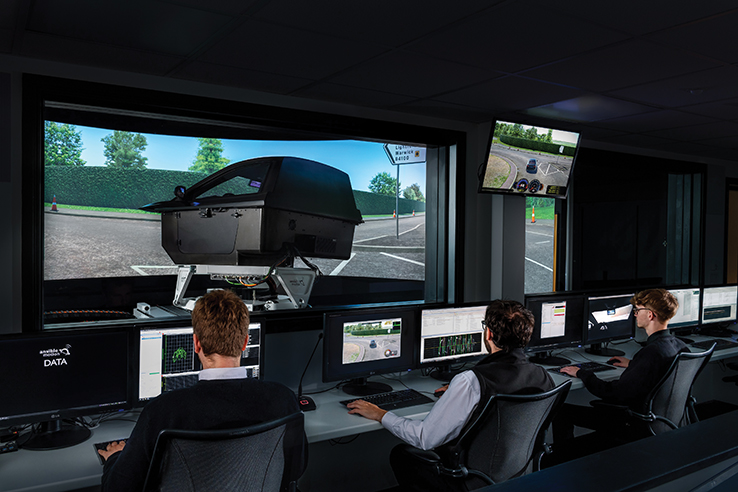
Ansible Motion has put a great deal of effort into developing products that deliver the abovementioned freedom in the most accurate, intuitive and results-driven way for their users. The latest iteration – the Delta Stratiform 3 (S3) – uses the company’s proprietary ‘six degrees of freedom’ motion platform, which it describes as feature-rich and highly scalable for different applications. On this, Haigh comments: “The platform produces high accelerations, high velocities, large displacements with high bandwidth, plus precise, low-latency dynamics for convincing reproduction of even the most subtle vehicle attributes. Many key driving manoeuvres can be conducted 1:1 with the real world, for unmatched realism.” Haigh proudly adds that, “For automotive development, there isn’t a more dynamic or capable simulator in existence.”
He also notes that the performance of the Delta S3 extends beyond motion dynamics: “It is a turnkey sensory immersion system, with everything required for convincing virtual test driving – including a 360°, 48K wrap-around projection screen with detailed world-space scenarios, quick-change cabin environments, and full integration of hardware- and software-in-the-loop elements. The idea is to provide test drivers and vehicle evaluators with a laboratory-based experience that matches real-world test driving as closely as possible.”
So, can automotive OEMs expect to have their development cycle accelerated by using Ansible Motion’s simulators? “Absolutely. Bringing sophisticated products to market faster than competitors, while simultaneously improving quality and reducing environmental impact is vitally important to automotive manufacturers,” answers Haigh. “One of our automotive OEM customers reports that simulator testing made it possible to halve its time to market and reduce the number of physical prototypes by 40%. But beyond the numbers, our DIL simulators are a way to invite early and often human contact into the vehicle design process – and this may be the real value proposition.”
Expanding on that latter point, Haigh says: “Manufacturers are able to learn a huge amount from real human interaction far earlier in the development process, providing opportunities to make significant improvements sooner rather than later, thereby avoiding costly mistakes and ensuring marketplace acceptance of new concepts that can provide a competitive edge.”
CUSTOMER SATISFACTION
Given that many of Ansible Motion’s customers come from the world of racing it’s no surprise that Haigh alludes to the competitive edge as a key benefit that DIL simulators can deliver. “We have 15 years’ experience working with some of the world’s largest automotive manufacturers, and at every level of professional motorsport including F1, WRC, WEC, NASCAR, INDYCAR and Formula E,” he details. “Since 2011, Honda’s engineers have relied upon our Delta DIL simulators to develop the brand’s automotive tech. When developing the Mustang Mach-E, our simulators helped Ford fine-tune the car’s suspension and tyre compounds long before physical prototypes were necessary.” He adds: “We also work with BMW Motorsport, Michelin, Continental, Chevrolet, DS Penske, General Motors, Lotus, University College London, Deakin University and many more.”
Naturally, Ansible Motion’s hardware must be able to work alongside its customers’ own software. So, how does the firm approach this side of things?
“We understand that some automotive manufacturers have deeply integrated in-house simulation and software solutions. This represents a considerable investment, and it can also mean that there is embedded intellectual property (IP) and know-how that needs to be protected,” Haigh observes. “As such, all of our simulator products are designed from the outset with a modular and open computational architecture to be adaptable and work in harmony with other toolsets. This seamless approach to driving simulator integration is largely made possible by our distributed data bus (DDB) real-time environment. Customers can continue to use their preferred hardware and software, with us providing all required integration connections. For customers without in-house software, we have the experience to recommend trusted solutions that have proved successful in-field applications. For example, our sister company, rFpro, provides highly realistic, engineering-grade simulation environments that are fully compatible with our DIL simulators.”
That need for realism is critical and Haigh explains that immersion is essential to ensure test drivers maximise their connection with the vehicle and onboard systems to ultimately achieve real-world physics correlation. “If one element isn’t up to scratch, then the illusion is broken. Our vision, motion and audio systems along with rFpro’s visual simulation environment combine to create an unparalleled, multi-sensory virtual testing environment,” he says. “We aim to create an immersive, multi-sensory environment that is convincing enough to give evaluators the illusion that they are interacting with a real vehicle – with vision, audio, vestibular and tactile/haptic sensory stimulation typically dominating the virtual vehicle interaction experience.”
Maintaining this scope for customisation and upgrade paths is how Ansible Motion ensures that its simulators stay ahead of the curve. “It’s important that we remain at the leading edge and anticipate the changing requirements of our customers,” Haigh states. “Often this has to do with integrating emerging technologies related to vision and computation systems – which are sometimes intimately related. For example, being able to integrate new graphics processing units (GPUs) as they become available on the market is a common upgrade path that can noticeably improve our customers’ experience.”
As the company supplies a broad range of interchangeable simulator subsystems that can be integrated independently or added to existing DIL simulators to equip them with the latest tech, this flexibility is fundamental to its business model. Haigh comments: “We’re able to be so adaptable and reactive due to the modular nature that’s inherent to our turnkey simulator ecosystems. Since we are often faced with unique customer interfacing requirements, our simulators have naturally evolved to be scalable and flexible. The same architectural and subsystem integration elements that make our simulators (out of necessity) adaptable to different customer applications are the driving force behind our ability to easily onboard new technologies as they become available.”
FROM ROAD TO RACETRACK
Ansible Motion’s simulators are suitable for simulating any type of ground vehicle – including passenger cars, high-performance race cars, commercial vehicles, motorcycles and more. “A Formula 1 car is, of course, a completely different beast from, say, a heavy goods vehicle (HGV),” Haigh notes. “But from our view, as a DIL simulator provider, there are actually more similarities than differences. Ultimately, different vehicle types are defined by their physics models – which for us is a replaceable software element. Then, of course, there is the cabin environment, which is an easily swappable simulator component. Beyond that, we are simply dealing with the human sensory elements – which are highly tuneable and reconfigurable.”
Haigh points out that the company has many OEM and research-oriented customers that assign their simulator usage to wildly different vehicle developments within the same day: “A morning simulator session might be dedicated to connected and autonomous vehicle (CAV) work, and then the afternoon session might be assigned to setting up a high-performance rally car to tackle Pikes Peak.”
CUSTOM BUILT
Customisation is a major selling point for Ansible Motion. “Our Delta series DIL simulators have an underlying modular architecture, meaning they have exceptional flexibility and scalability to adapt to unique applications and use cases,” Haigh explains. Elements can be modified, removed or replaced with real-world hardware and software elements. Motion space and overall performance are highly scalable: cabins can be changed quickly – in less than 45 minutes – to offer support for multiple programmes or divisions. Haigh comments: “This means more than being able to easily make the changes needed for daily virtual test driving: it means having a DIL simulator that is fundamentally futureproof because key elements can be easily upgraded over time to keep up with emerging simulation technologies.”