
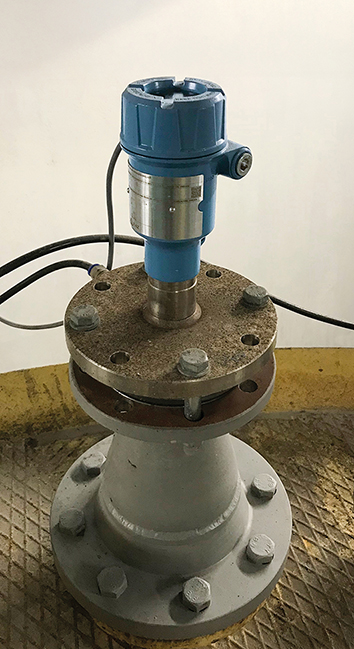
Emerson’s Sara Anderberg explains how intelligent signal processing enables non-contacting radar level transmitters to ensure measurement accuracy
Non-contacting radar level transmitters provide extremely accurate measurements in a wide range of applications and process conditions. However, tanks containing internal objects have traditionally proven challenging for this technology because these obstructions can interfere with radar signal processing and impact measurement accuracy. Radar devices calculate level by emitting microwave signals that reflect back to the transmitter from the material surface. However, tank obstructions can also reflect signals, making it necessary for transmitters to distinguish the real material surface echo from false echoes emanating from obstructions. Should a transmitter interpret a false echo as genuine, it could result in an inaccurate level reading and potentially lead to an overfill and spill. In tanks containing hazardous substances, this could endanger workers and cause costly environmental damage. Incorrect readings could also lead to an underfill, causing production inefficiencies or disruptions.
Alternative solutions
If a tank has an existing nozzle providing an unobstructed view to the material surface, the radar transmitter should of course be positioned there. However, this is rarely the case, so alternative solutions are required to mitigate against obstructions. For example, angled deflector plates can redirect radar signals that would otherwise reflect off an obstruction and back to the transmitter. This enables the true material level to be distinguished more easily. Deflector plate installation can be challenging, however, especially in tanks with complex geometry or access limitations. Incorrectly positioned plates can block part of the radar signal, creating measurement ‘blind spots’, while material build-up on plates can alter their angle of reflection.
Radar devices can also create a threshold that prevents false echoes from being considered as valid. Known as false echo suppression, this can be effective but also has limitations. For example, a tank needs to be emptied when establishing the threshold, which is inconvenient and can prolong commissioning. Also, the characteristics of echoes from obstructions can evolve over time, owing to factors such as changes in the vapour space or temperature, or coating from the process. Because a device creates a threshold based on echo characteristics at that time, any changes to echo characteristics may result in false echoes no longer being excluded from consideration.
Rosemount non-contacting radar level transmitters from Emerson feature functionality that enables accurate level measurements in tanks with obstructions, without having to install deflector plates or run false echo suppression. A patented powerful signal processing algorithm known as Smart Echo Supervision dynamically evaluates the behaviour of all viable echoes in real time, then ranks them according to which behave most like a genuine surface echo over time. The echo that most behaves like a reflection from the material surface is then tracked as the genuine surface echo, with all others automatically suppressed. Crucially, the technology continually adapts to changes in echo characteristics, enabling Smart Echo Supervision to reduce or even eliminate the need for intervention against false echoes.
For more information, visit: www.Emerson.com/RosemountNonContactingRadar