These new chips are enabling car manufacturers to advance vehicle autonomy and safety within their automotive portfolio
These new chips are enabling car manufacturers to advance vehicle autonomy and safety within their automotive portfolio
Technological innovation within autonomous and Advanced Driver Assistance Systems (ADAS) is growing in momentum exponentially, as consumers demand more capabilities from their vehicles. Matching this demand, Texas Instruments (TI) has introduced a new range of automotive lidar, clock and radar chips to help manufacturers bring more autonomous features to a wider range of cars.
“Our latest automotive analogue and embedded processing products help automakers both meet current safety standards and accelerate toward a collision-free future,” says Andreas Schaefer, TI general manager, ADAS and infotainment. “Semiconductor innovation delivers the reliability, precision, integration and affordability automakers need to increase vehicle autonomy across their entire fleet.”
REAL-TIME DECISION MAKING
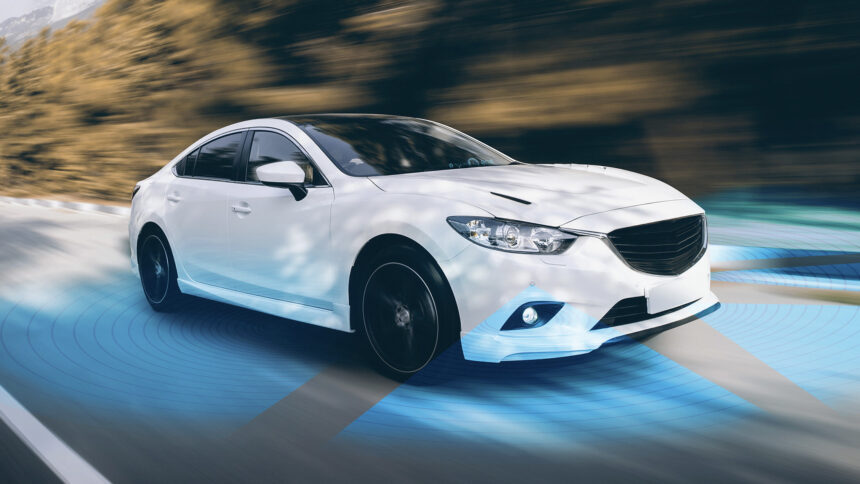
Lidar is a key technology for autonomous vehicles, providing a detailed 3D map of the driver’s surroundings to enable vehicles to detect and react to obstacles, traffic and road conditions. The first product in TI’s new range is the LMH13000 – the industry’s first integrated high-speed laser driver to deliver an ultra-fast 800ps rise time, achieving up to 30% longer distance measurements than discrete solutions.
Eliminating the need for large capacitors or additional external circuitry, the device features integrated low-voltage differential signalling (LVDS), complementary metal-oxide semiconductor (CMOS) and transistor-transistor logic (TTL) control signals. According to TI, this integration supports an average 30% reduction in system costs while reducing solution size by four times. As a result, design engineers can discretely mount compact, affordable lidar modules in more areas and across more vehicle models.
“One of the most important features of the device is the capability to provide pulses with only 2% variation over temperature,” says Anthony Vaughan, marketing manager high-speed amplifiers at TI. “The LMH13000 provides LIDAR developers with the ability to perform faster and more accurate object detection. Multiple devices can be used in parallel to achieve an even higher current.”
DESIGNING RELIABLE ADAS
Reliability is the cornerstone of electronics design for ADAS and in-vehicle infotainment systems. Devices must be able to work reliably in the face of temperature fluctuations, vibration and electromagnetic interference. Equipped with TI’s BAW technology, the company’s new CDC6C-Q1 oscillator and LMK3H0102-Q1 clock generators increase reliability by 100 times compared to traditional quartz-based clocks, with a failure-in-time rate of just 0.3. Enhanced clocking precision and resilience in harsh conditions enable safer operation, cleaner data communication and higher-speed data processing across next-generation vehicle subsystems.
“TI is launching a complete portfolio of automotive clocking products based on our unique vocal acoustic wave technology,” says Xiaofan Qiu, the company’s product line manager, clock and timing solutions. “The clock is the heartbeat of every electronics system. Every microcontroller, high speed interface and data converter requires accurate clock references for them to function. At the heart of every clocking device is the resonator which generates the clock. Bulk acoustic wave is a TI resonator technology that uses PSO transduction to generate gigahertz frequency and a high Q resonance that can be integrated directly into a standard package containing other integrated circuits. TI is the first and only company that has productised this technology for timing.”
As Qui says, today’s cars are “becoming like servers on four wheels”, requiring huge amounts of computing and data to enable autonomous features. “As a result, this requires higher performance SOCs with high speed interfaces, which will require higher performance clocks,” he says. “The amount of electronics within these systems is continuing to grow, so having a solution that can help simplify the design and solution size are highly preferred by customers.”
IMPROVING VEHICLE SAFETY
The final new launch within TI’s portfolio is a new front and corner radar sensor, the AWR2944P, which build on the company’s existing AWR2944 platform. The new sensor’s enhancements are designed to improve vehicle safety by extending detection range, improving angular accuracy and enabling more sophisticated processing algorithms.
Some of the sensor’s key features include an improved signal-to-noise ratio, increased computational capabilities and larger memory capacity. The sensor also features an integrated radar hardware accelerator that allows the microcontroller and digital signal processor to execute machine learning for edge artificial intelligence (AI) applications.
The new spate of automotive lidar. Clock and radar launches from TI is set to help engineers design adaptable ADAS for a safer, more automated driving experience, the company says. An automotive-qualified version of the LMH13000 is expected to be available in 2026, with preproduction quantities of the LMH13000, CDC6C-Q1, LMK3H0102-Q1, LMK3C0105-Q1 and AWR2944P available to purchase now.