These subsea units shave days off testing times
These subsea units shave days off testing times and eliminate human error from the monitoring process, explains Cynthia Pikaar.
According to World Ocean Review, around one third of oil & gas reserves worldwide are extracted from offshore sources. To reach these underwater oil & gas fields, specialised equipment is needed. However, repairs and interventions with subsea appliances quickly become costly. It is therefore vital that the electrical assets of subsea testing are regularly monitored.
A common reason subsea electrical systems fail is water ingress into the system. For subsea umbilicals, electrical integrity damage can occur anytime during their lifetime.
C-Kore’s subsea testing tools, the C-Kore Cable Monitor and the C-Kore Subsea TDR allow the installation or IRM contractor to quickly check the electrical integrity of subsea umbilicals. The Cable Monitor checks the insulation resistance and continuity of the electrical lines while the Subsea TDR unit looks for anomalies along the electrical lines by sending out a pulse and listening for the reflections, much like a radar.
By knowing how long the reflections take to get back to the source, the distance to the anomaly can be calculated, which can dictate the repair (or indeed replacement) scenario for the operator.
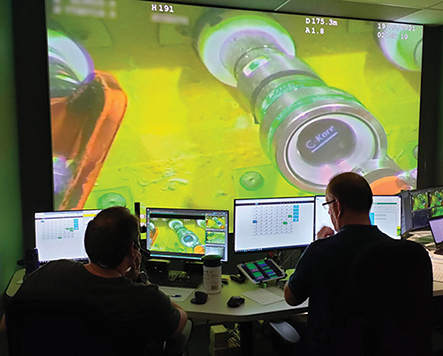
The units are pre-programmed to run a specific test routine, which typically only takes a few minutes. The information is then data logged and captured by the ROV’s camera. With the Cable Monitor readings the individual electrical lines can quickly be determined to be ‘good’ or ‘bad’, while the Subsea TDR determines where along the line the anomaly is. These values can be downloaded later into reports and graphs, easily documenting the testing results.
Because the units are autonomous, they do not require a specialised C-Kore engineer to accompany them offshore – a significant cost saving for offshore campaigns. By plugging directly into the umbilical and automating the testing process, the results are quick, accurate and repeatable.
C-Kore also provides remote data analysis support. Some customers have said they have saved days of testing on their offshore mobilisations.
The units all contain wet-mate connectors, which allow easy connection into the system to be tested, either on-land or subsea. They can be installed on the umbilical while it is still on the vessel, or they can be installed once the umbilical is on the seabed.
This level of flexibility is possible because of the research done prior to installation. The C-Kore team talks to the engineers to understand the system, the connectors that are required, and the testing they want to accomplish. The experts then programme the units prior to dispatch. A test routine is run on either a set schedule or by activating the units via the light or proximity sensor.
C-Kore will continue developing itsproducts based on operator needs. Its latest tool, the Subsea Optical TDR, allows operators to test the optical fibres in umbilicals while they are subsea. The new tool is attracting attention from operators the world over, already being deployed in both the Gulf of Mexico and the North Sea.
Cynthia Pikaar is with C-Kore.