Electrification is reshaping oil and gas site power systems. As fuel-driven equipment is replaced and renewable generation increases, local networks must remain stable under changing electrical conditions. This is increasingly important as the International Energy Agency (IEA) estimates oil and gas supply operations account for nearly 15% of global energy-related greenhouse gas emissions.
Here, Mark Newman, business development manager for Energy Transition, Industrial Decarbonisation and Grid Stability at WEG, explains why synchronous condensers and BESS should form part of decarbonisation plans.
As operators retire local gas-turbine generation and rely more on converter-connected assets, site networks can exhibit weak-grid characteristics. Reduced fault levels and lower system inertia mean the issue is not only energy availability, but whether the local network can remain stable as operating conditions change.
According to the IEA, the production, transport and processing of oil and gas generated 5.1 billion tonnes of CO2-equivalent emissions in 2022, just under 15% of global energy-related greenhouse gas emissions.1 The agency also says more than 80 million kilometres of power lines will need to be added or refurbished by 2040 to meet national climate and energy goals, a scale equivalent to the entire existing global grid.
Higher use of inverter-based resources changes the way a network responds to faults. Renewable generation and battery energy storage systems are essential to decarbonisation, but they do not behave like traditional rotating machines. Conventional generators naturally provide physical inertia. They can also support fault levels and help stabilise voltage during disturbances.
A WEG Battery Energy Storage System (BESS) can deliver fast active-power response, while improving site energy flexibility. Advanced grid-forming BESS can also provide stability functions such as synthetic inertia and controlled fault-current contribution. However, grid-forming converters do not inherently replicate the physical inertia or natural fault-current response of a rotating synchronous machine.

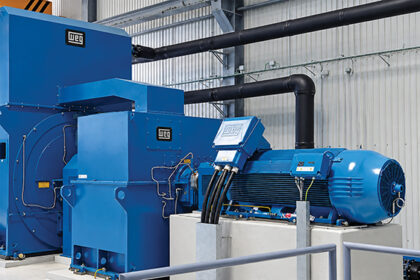
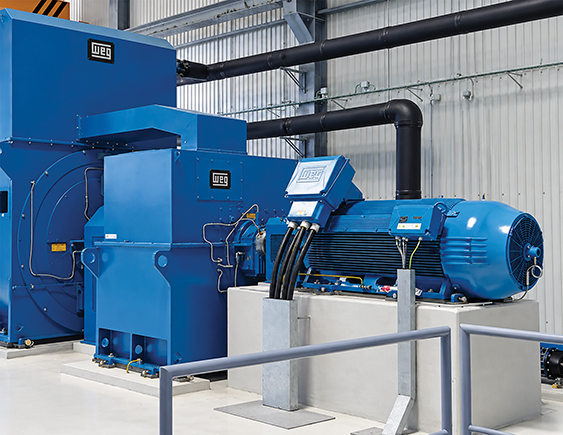
That is why WEG Synchronous Condensers have an important role where sites need a stronger electrical foundation for reliable operation. A synchronous condenser, or SynCon, is a rotating electrical machine connected to the grid without driving a mechanical load. It provides real inertia from rotating mass. Unlike synthetic inertia, which is delivered through control algorithms, the kinetic energy stored in a synchronous condenser rotor is available instantaneously.
A synchronous condenser can also strengthen fault levels and help anchor the local voltage reference. Higher fault current levels can improve protection system performance and support large motor starting duties. For operators, insufficient system strength can be measured in nuisance trips and production losses caused by failed motor starts. When equipped with a flywheel, a WEG flywheel-assisted Synchronous Condenser can store more kinetic energy, improving frequency stability further.
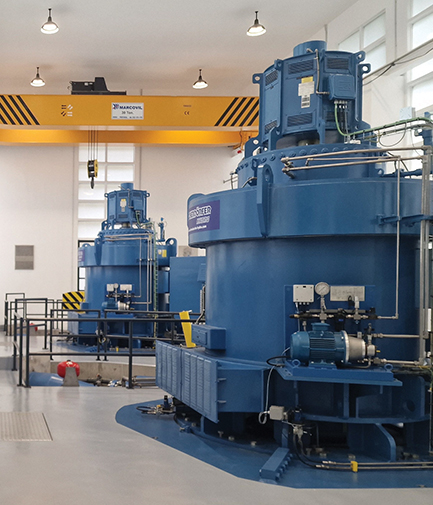
WEG’s work with Empresa de Eletricidade da Madeira (EEM) provides a transferable example. Madeira is an isolated island grid with no synchronous interconnection. In 2025, the island had a renewable share of 37.4%, while instantaneous renewable penetration could reach 70% during off-peak hours. The grid also showed stability challenges, including low short-circuit current and frequency stability limits.
EEM’s response combined storage with synchronous support. Existing hydro units were adapted to operate in synchronous condenser mode, BESS capacity was introduced at strategic nodes and a dedicated flywheel-assisted SynCon was installed at Caniçal.

Although industrial electrification projects differ from island power systems, both can experience low fault levels, limited inertia and high penetrations of converter-connected generation. The important step is to identify the binding constraint before choosing the asset. If the issue is energy shifting, BESS may be the priority. If the site also needs stronger fault levels or a firmer voltage reference, a SynCon may be required alongside storage.
WEG’s synchronous condenser solutions are designed around system requirements, not machine convention. In Madeira, the design was shaped by fault-current contribution and inertia, with reliability through grid disturbances built into the specification. The system used a low-voltage variable speed drive (VSD) and pony motor starting arrangement to ramp the machine to near-synchronous speed before connection, avoiding the inrush current that direct-on-line starting could create in a weak system.
Commissioning is equally important. Weak-grid projects cannot be treated as standard handovers, because voltage and frequency can fluctuate continuously. On Madeira, synchronisation logic and drive firmware had to be tuned against real operating behaviour. For oil and gas assets, unstable power systems can be costly and difficult to restart.

As the sector decarbonises, the priority is a resilient electrical architecture that allows cleaner generation and storage to operate without compromising uptime. WEG can support that approach with SynCon and BESS solutions, while its motors and drives, supported by automation expertise, help operators improve efficiency at the point of use.
Electrification will continue to reshape oil and gas power systems, but the transition will only succeed if stability is designed into the network from the beginning. For remote or weak-grid sites, synchronous condensers can provide the physical foundation that allows lower-carbon technologies to operate reliably.
For more information visit: www.weg.net
[References]
1 Emissions from Oil and Gas Operations in Net Zero Transitions – Analysis – IEA