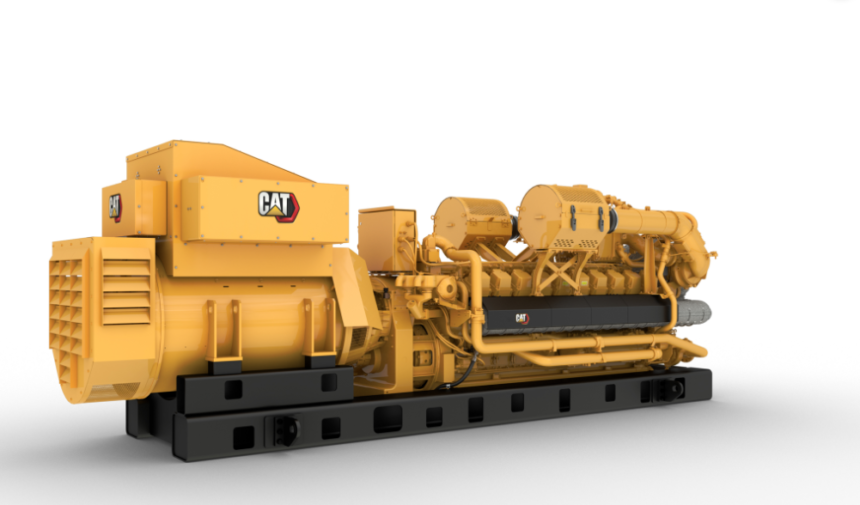
Caterpillar Inc. announces new CAT G3520 Fast Response which can accept loads from cold starts, for 50Hz applications.
Caterpillar Inc. has announced a new Cat G3520 Fast Response machinery which reduces tailpipe emissions, generating natural gas with less greenhouse gas emissions. This is for 50Hz applications and can take on high load acceptance and transient response for mission-critical operations.
Designed to be in line with the ISO8528-5 G2 standard, the CAT G3520 delivers 2.6MW (3250kVA) for emergency standby and demand response. The device can start and accept load within 10 seconds of application, whilst being able to receive and recover from a 100% block load.
Melissa Busen, vice president for Caterpillar’s Electric Power Division said: “As our global customers look for mission-critical power that can also help meet their sustainability goals, the Cat G3520 Fast Response generator set provides a high-performance, natural-gas option that helps reduce their greenhouse gas emissions when compared with traditional backup solutions.”
The CAT G3520’s power-dense capabilities are ideal for hospitals, data centers, retail complexes, schools, government buildings, universities and industrial facilities.
Certified by the US Environmental Protection Agency (EPA), Caterpillar supplies 60Hz standby power nodes, ranging from 750kW to 2.5MW. These can be used in emergency and non-emergency situations. The CAT3520 Fast Response is the latest in Caterpillar’s portfolio of natural gas power solutions.
The control system comes with an ethernet connection and communication capabilities to allow integration into building management systems. This allows for greater control and allows for compatibility across systems. It features Caterpillar’s EMCP 4 control system, which can set up, control, monitor and protect the system.
The Cat Energy Control System (ECS) allows customers to manage energy needs, from just a single generator to set of cohesive full-site microgrid solutions. These can be optimised for resiliency, emissions and cost. These controllers can be integrated into the system and scalable for the task required.