
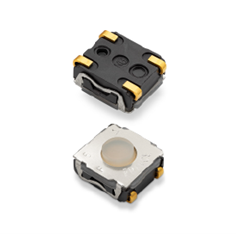
Why gold-plated tactile switches outperform conventional contact in low-current, long-life building automation systems
Reliability in building automation systems increasingly depends on the performance of human–machine interface (HMI) components, the physical switches and controls that allow users to interact with electronic systems
In applications such as smart meters, access control panels, and HVAC controllers, HMI tactile switches must deliver consistent electrical signals over long service lifetimes, often while operating at very low currents and in environments exposed to humidity, temperature cycling, and airborne contaminants.
For electronics design engineers, the choice of switch contact material plays a critical role in maintaining signal integrity and preventing intermittent failures. Gold-plated tactile switches are widely used in building automation HMIs because gold resists oxidation and corrosion, maintains stable contact resistance in low-current (“dry-circuit”) conditions, and supports reliable operation over millions of actuations. Compared with tin- or silver-plated contacts, gold-plated contacts provide more predictable long-term performance in applications where maintenance access is limited and system uptime is essential.
As smart buildings continue to adopt connected, low-power control electronics, understanding when and why to specify gold-plated tactile switches has become an important part of designing reliable, long-life HMI systems.
Why Gold Plating Matters in Modern Building Systems
Every tactile switch operates through momentary metal-to-metal contact. Over time, environmental exposure, humidity, pollutants, or airborne chemicals, can create oxide films that increase contact resistance or lead to intermittent switching. The plating material determines how resilient those contacts are against these factors.
- Tin provides low cost but oxidizes quickly, particularly in humid conditions, leading to rising resistance and unreliable actuation.
- Silver offers excellent conductivity but tarnishes in the presence of sulfur, forming insulating sulfides that interfere with low-current signals.
- Gold, by contrast, is chemically inert—it does not oxidize or tarnish, maintaining consistent, low contact resistance for the life of the switch.
For smart building and metering systems, which often operate with low signal currents and extended service lifetimes, gold-plated contacts offer an essential layer of protection and predictability.
Applications Where Gold Excels
Gold plating provides the greatest value in building automation and control systems where environmental exposure, long duty cycles, and low operating currents converge.
1. Smart Electricity, Gas, and Water Meters
Meters are typically installed in outdoor or semi-exposed locations, where humidity, temperature swings, and atmospheric pollutants can compromise standard materials. Inside these enclosures, tactile switches are used for configuration, calibration, and maintenance interfaces.
Gold-plated contacts ensure stable electrical performance over decades, resisting corrosion that might otherwise alter calibration or interrupt communication. For example, C&K’s KMR623NG ULC LFG tactile switch, featuring gold-plated contacts and an IP67-rated sealed design, offers the combination of environmental protection and long lifecycle performance that utility metering systems require.
2. Access Control and Security Devices
From smart locks and keypad panels to badge readers and alarm systems, access-control electronics operate in variable temperature and humidity conditions, often near doorways or exterior walls. Gold plating ensures that signal paths remain clean and noise-free, even after years of exposure to moisture and contaminants.
The KSC223J LFG switch exemplifies this advantage. With gold-plated contacts, a compact footprint, and robust mechanical endurance, it maintains stable actuation force and resistance over up to one million cycles, making it ideal for keypads, security terminals, and building control interfaces that must work flawlessly every time.
3. Smart HVAC and Environmental Controls
Thermostats, air-quality monitors, and lighting control panels are increasingly connected to building management systems. These devices often rely on microamp-level switching in their user interfaces and sensor circuits. Gold’s oxide-free surface guarantees consistent conduction even at very low currents, eliminating false triggers and erratic readings that can occur with oxidized or tarnished contacts.
Engineering Advantages of Gold-Plated Contacts
Stable Electrical Behavior in Low-Current Circuits: In modern IoT-based control systems, switch currents can fall below 10 mA. Under these conditions, oxide films on non-noble metals act as insulators, introducing contact resistance and noise. Gold plating prevents these films from forming, maintaining clean, repeatable signal transmission throughout the product lifecycle.
Reduced Contact Bounce and Noise: Mechanical contact bounce can create unstable signals and false activations. Gold’s smooth, uniform surface minimizes micro-asperities that contribute to bounce, resulting in faster, cleaner transitions and simpler circuit design, often eliminating the need for debounce circuitry or software filtering.
Thermal and Environmental Stability: Home and building automation products may experience broad temperature ranges, from unheated meter boxes to sun-exposed outdoor enclosures. Gold’s resistance to thermal expansion and contraction preserves contact alignment and mechanical integrity under repeated cycling.
Resistance to Fretting and Metal Whiskers: In high-vibration environment, such as wall-mounted HVAC controls or industrial utility meters, minute contact motion can cause fretting corrosion in conventional materials. Gold’s lubricious, oxidation-free surface prevents this degradation. It also eliminates the risk of tin whiskers, which can form on other plating types and cause short circuits over time.
Design Considerations and Lifecycle Economics: Gold plating adds a small incremental cost compared to tin or silver, but it provides substantial value in applications where failure costs are high or service access is difficult. In smart meters, for example, each replacement requires a site visit and recalibration, costing far more than the switch itself. Similarly, downtime in building automation systems can disrupt HVAC or security functions and affect user comfort or safety.
By specifying gold-plated tactile switches early in design, engineers can:
- Eliminate field failures caused by corrosion or oxidation.
- Ensure signal reliability in microcontroller and sensor circuits.
- Maintain consistent tactile feel and actuation force across millions of cycles.
- Reduce maintenance costs over the product’s service life.
Designers can also tailor plating performance through stack configuration, typically a gold layer over a nickel barrier, to prevent copper diffusion and ensure uniform plating thickness.
Real-World Example: Gold Plating Pays Off in High-Heat Appliance Design
A recent design win highlights how gold plating can deliver measurable performance and reliability benefits—even in cost-conscious product segments.
When a home cooker control module manufacturer encountered switch reliability issues at elevated operating temperatures, the engineering team turned to a gold-plated tactile switch solution. Despite the higher material cost, the gold-plated contacts maintained stable conductivity and tactile feedback across repeated high-temperature cycles—conditions that caused conventional plated contacts to oxidize and degrade.
The result: improved operational reliability, reduced warranty claims, and extended product lifetime.
This case demonstrates that application-specific demands, particularly exposure to heat, humidity, or prolonged duty cycles—can make gold-plated switches the most cost-effective choice over the product’s full lifecycle.
Balancing Cost, Performance, and Application Needs
While gold plating is not justified in every product, it becomes essential when reliability, environmental resilience, or long lifecycle operation is required. Engineers should evaluate:
- 1. Current Level: For dry-circuit or signal-level switching (<100 mA), gold plating is recommended.
- 2. Operating Environment: High humidity, temperature extremes, or pollutant exposure make gold advantageous.
- 3. Lifecycle Expectations: Long-life meters or access controls with minimal maintenance justify the premium.
- 4. Tactile Feel and Consistency: Gold’s smooth contact surfaces maintain the crisp actuation response users expect.
Switch families such as C&K’s KMR623NG ULC LFG (sealed, ultra-low current) and KSC223J LFG (compact, long-travel, long-life) provide flexible solutions for engineers balancing performance with cost constraints while maintaining footprint compatibility across multiple product platforms.
Designing for Performance Over the Full Product Lifecycle
In modern building automation systems, reliability must be measured over years of real-world operation—not just initial performance at the factory. As devices are deployed in increasingly demanding environments and operate with ever-lower signal currents, component-level decisions play an outsized role in long-term system behavior.
Gold-plated tactile switches address these challenges by delivering stable electrical performance, resistance to environmental degradation, and consistent mechanical response
throughout the product lifecycle. For engineers designing smart meters, access controls, or HVAC interfaces, selecting gold-plated contacts is less about material preference and more about risk mitigation, reducing service calls, preventing intermittent failures, and ensuring that critical user interfaces perform as intended for the life of the system.
In building automation, where reliability underpins user trust and system safety, contact material selection becomes a strategic design choice—one that directly links component engineering to long-term system success.
Sidebar: When to Specify Gold-Plated Tactile Switches
- Smart meters (electricity, gas, water): Long field life and moisture exposure demand corrosion-proof reliability.
- Access controls and security panels: Low-current keypads and badge readers require stable, noise-free contact signals.
- Smart HVAC and lighting systems: Continuous operation and low-voltage logic control benefit from gold’s oxide-free surface.
- Outdoor or unconditioned enclosures: Wide temperature and humidity variation calls for thermally stable materials.
Bottom line: In connected buildings and smart energy systems, gold plating delivers the durability, precision, and signal integrity that keep essential functions running smoothly for decades.
Contributed by Michaela Schnelle, senior associate product manager at Littelfuse.