Railways are undergoing a transformative period driven by advances in sensor technologies
Railways are undergoing a transformative period driven by advances in sensor technologies that promise to improve safety, reduce downtime, cut emissions, and prepare the sector for full automation
This article rounds up some of the key recent developments across the rail industry, from wireless-powered sensors and real-time track temperature monitoring, to autonomous vehicle perception systems and a Europe-wide strategy for innovation.
SMARTER CONDITION MONITORING
RX Watt, a University of Glasgow spinout, has introduced a new class of battery-free sensors designed for real-time monitoring of rolling stock. These sensors harvest energy from radio frequency (RF) signals and wirelessly transmit key operational data such as temperature, vibration, and strain via Bluetooth. This eliminates the need for wired installations or battery replacements, reducing environmental impact and maintenance costs.
Tested successfully at the BCIMO Very Light Rail Innovation Centre, the RF-powered sensors were shown to operate effectively on real rail vehicles, including trams and passenger carriages. Their ability to retrofit into existing systems without major infrastructure changes opens significant opportunities for rolling stock operators focused on preventive maintenance and sustainability.
Dr. Mahmoud Wagih, founder of RX Watt and a lecturer at the James Watt School of Engineering, said: “Monitoring air quality, occupancy, and wear and tear are crucial to sustainable and resilient transport. With radio-frequency power delivery, we eliminate the dependence on batteries or energy harvesting from the environment, enabling continuous, maintenance-free monitoring.”
This advancement aligns with the UK’s broader innovation goals, having received backing from Innovate UK under the Contracts for Innovation programme, and reflects growing recognition of the role that low-maintenance, low-power sensing will play in modern rail systems.
TACKLING TRACK FAILURES
Hot weather continues to pose a major threat to railway safety. Steel rails expand in heat, and if unmanaged, can buckle, posing derailment risks and causing extensive service delays. In 2024 alone, rail buckling was responsible for 240 days of cumulative delays in the UK.
Historically, manual magnetic thermometers have been used to monitor track temperatures—an approach that is both labour-intensive and disruptive. However, since 2023, Network Rail has partnered with suppliers to deploy remote rail temperature sensors capable of taking readings every 15 minutes and transmitting data via mobile networks.
These smart sensors send automated alerts when specific temperature thresholds are reached, enabling timely intervention without manual trackside monitoring. This development not only increases safety but also improves operational efficiency by allowing targeted speed restrictions instead of blanket slow-downs.
The system is already in use across several regions, with ambitions for network-wide implementation, particularly as climate change continues to exacerbate extreme temperature events.
FULLY AUTOMATED
Another critical frontier is the move toward fully automated, driverless train operations. In Germany, the AutomatedTrain project – led by Digitale Schiene Deutschland (Digital Rail Germany) – is piloting technologies to enable automated train preparation, staging, and storage.
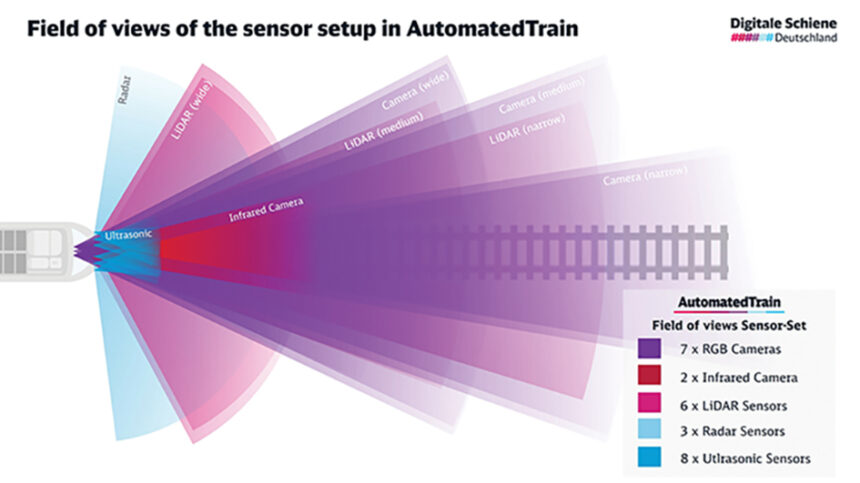
The project, in collaboration with Siemens Mobility and Bosch Engineering, integrates an advanced multi-modal environmental sensor suite into Siemens Mireo and Alstom Class 430 S-Bahn trains. This setup includes:
- 6 Lidar units for mid- and long-range detection
- 7 HDR colour cameras for object recognition
- 3 radar sensors for mid-range obstacle detection
- 8 ultrasonic sensors for close-range awareness
- 2 long-wave infrared (LWIR) cameras to detect heat sources
These sensors are designed to deliver human-equivalent situational awareness, functioning reliably in varied environmental conditions such as fog, snow, and darkness. The fusion of sensor inputs is used to develop AI-based perception algorithms, which will be validated at the Siemens Mobility Test and Validation Centre and in field tests on the Stuttgart S-Bahn.
The system is supported by a robust data infrastructure including a Vehicle Data Logger and a centralised data factory that processes and uses the data for continuous machine learning model improvement. This scalable approach is essential for achieving safe, interoperable automated rail operations across diverse train types and use cases.
COORDINATED STRATEGY
All these innovations are aligned with the vision laid out by the Europe’s Rail Joint Undertaking (EU-RAIL) in its recent high-level paper advocating for a bold public-private investment strategy in rail innovation. The plan proposes €18 billion in co-investment from 2028 to 2034, with €3 billion dedicated to research and innovation and €15 billion for pre-deployment activities.
Among the priorities are:
- Agility: Through modular digital systems and streamlined certification
- Resilience: With emphasis on cybersecurity and climate adaptation
- Competitiveness: By lowering lifecycle costs and increasing industrial leadership
Giorgio Travaini, executive director of Europe’s Rail JU, said: “By simplifying the rail system and reducing complexity, we can increase economies of scale and make the sector more competitive. This creates lasting value for both large and small players across the European rail ecosystem.”
The strategy underlines the importance of interoperable sensor-enabled solutions as foundational to the Single European Rail Area (SERA), helping to triple high-speed passenger rail use and double freight transport by 2050.