A recent whitepaper from global engineering firm Allient provides a technical overview of motor technologies
Unmanned aerial vehicles (UAVs), commonly referred to as drones, have evolved from experimental platforms into mission-critical systems across defence, industrial, and commercial sectors
Modern drones support applications ranging from intelligence and surveillance to infrastructure inspection, logistics, agriculture, and emergency response. As these platforms become more capable and autonomous, the performance demands placed on their electromechanical subsystems have increased significantly.
A recent whitepaper from global engineering firm Allient provides a technical overview of motor technologies used in drone systems, key performance parameters, and the engineering considerations that guide motor selection.
DRONE-BASED MOTOR APPLICATIONS
Electric motors serve multiple functions within a drone platform, broadly divided into propulsion and precision motion systems. The most visible application of motors in UAVs is propulsion. In multi-rotor platforms, individual lift motors generate the thrust required for vertical take-off, hovering, and manoeuvring. In fixed-wing or hybrid vertical take-off and landing (VTOL) aircraft, propulsion systems may include separate motors optimised for vertical lift and forward flight.
Some advanced UAV architectures incorporate tilting or rotating propulsion assemblies that transition between vertical and horizontal orientations during flight. These mechanisms impose additional mechanical and control requirements on motor systems, particularly regarding torque control, structural robustness, and dynamic response.
PRECISION MOTION AND PAYLOAD SYSTEMS
Motors are also widely used in payload stabilisation and positioning mechanisms. Gimbal systems supporting cameras, radar, LiDAR, and other sensors rely on precision motors to maintain stable orientation under dynamic flight conditions.
Unlike propulsion motors, gimbal motors must provide extremely smooth torque output, minimal cogging, rapid acceleration, and fine positional control. Additional auxiliary motors may also be integrated into control surface actuators, landing gear systems, or mission-specific mechanisms.
MOTOR TECHNOLOGIES USED IN UAVS
Most drone systems rely on brushless electric motor technologies due to their efficiency, reliability, and controllability. Outer-rotor configurations are widely used in propulsion systems. In this architecture, the rotor surrounds the stator, allowing the propeller to be mounted directly to the rotating
outer shell.
This topology provides several advantages for drone propulsion:
- High torque output at relatively low rotational speeds
- Simplified mechanical integration with propellers
- Improved cooling due to rotor exposure to airflow
Outer-rotor motors typically have higher inertia than inner-rotor designs; however, in most UAV applications the propeller inertia dominates system dynamics, making this trade-off acceptable.
Inner-rotor motors are more common in gimbals and auxiliary motion systems. Because the rotor is located inside the stator, these motors exhibit lower rotational inertia and faster dynamic response. Many are implemented in frameless configurations, allowing direct integration into custom mechanical structures and also into existing bearing assemblies.
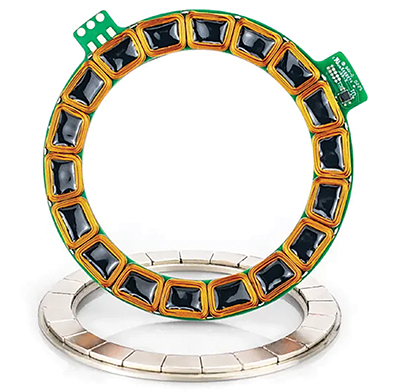
Axial flux motors are an emerging option for UAV applications, particularly where compact form factors are required. These motors feature a large diameter and short axial length, enabling high torque density and low-profile packaging. Their geometry makes them particularly attractive for precision motion systems such as gimbals, where space constraints and smooth torque characteristics are critical.
KEY PERFORMANCE PARAMETERS
Motor selection for drone systems differs significantly from traditional industrial motor sizing. In propulsion systems, thrust generation is typically more relevant than torque alone. Engineers must evaluate how much thrust a motor–propeller combination can produce relative to its own mass and the overall system weight. High thrust-to-weight ratios are essential for payload capacity, manoeuvrability, and climb performance.
Motor efficiency directly impacts energy consumption and therefore flight duration. High-efficiency motors reduce battery load, enabling longer mission times and reducing thermal stress on the propulsion system. Efficiency must be evaluated at realistic operating points rather than peak conditions.
The KV rating, which defines the relationship between motor speed and applied voltage, must be matched carefully to the propeller and mission profile. An improperly matched KV value can reduce efficiency, increase thermal stress, or limit thrust capability.
Mechanical characteristics – including bearing life, vibration behaviour, and structural robustness – are particularly important for long-duration or high-performance UAV platforms.
DESIGN ENGINEERING CHALLENGES
Thermal design is one of the primary engineering challenges in UAV propulsion systems. Unlike many industrial motors, drone motors rely heavily on airflow generated by propeller motion and forward flight for cooling. This airflow enables significantly higher power density but also complicates performance specifications. A motor rated for high power under forced airflow may overheat rapidly if operated without sufficient cooling. Engineers must therefore evaluate thermal assumptions when comparing motor ratings.
Weight minimisation is a dominant design constraint. In many cases, designers accept operating conditions that would be avoided in traditional industrial machines, such as pushing magnetic materials closer to saturation. Although this can introduce nonlinear electromagnetic behaviour, it may be justified when the goal is maximising power output per unit mass.
Reliability expectations also differ from conventional industrial equipment. While industrial motors may be designed for decades of service, many drone motors are optimised for operational lifetimes measured in hundreds or thousands of hours. Understanding these trade-offs is essential when balancing performance, durability, and mission risk.
EMERGING TRENDS
Several trends are shaping the future of UAV motor design. Increasing demand for supply-chain assurance and regulatory compliance is driving greater emphasis on traceable components and controlled manufacturing processes.
At the same time, system designers continue to push for higher power density, improved thermal utilisation, and tighter integration between propulsion, sensors, and structural components. Emerging mission profiles – including hybrid VTOL aircraft, counter-UAS systems, and long-endurance surveillance platforms – are introducing new requirements for continuous operation and high reliability.
For engineers developing next-generation drone platforms, successful motor integration requires careful consideration of thrust generation, thermal behaviour, efficiency, and mission-specific constraints. By evaluating motors within the context of the complete propulsion system, including propellers, airflow conditions, and operational profiles, engineers can optimise performance while maintaining system reliability and mission assurance.