Additive manufacturing is moving beyond the hype and is increasingly evaluated as an industrial production technology based on concrete applications, qualified materials, process repeatability, and economic return, rather than geometric freedom alone
Its adoption should begin at the design stage, to fully leverage feature and component integration, reducing sub-assembly complexity and unlocking performance gains that conventional manufacturing cannot reach.
AM is leaving the prototype lab and entering low-rate initial production—evaluated today on qualified materials, process repeatability, and measurable return, Windform components have already supported over 10 orbital missions and the deployment of over 57 PocketQubes, demonstrating how AM is enabling flight-qualified applications. The shift is substantial: the most successful applications no longer originate from adapting conventionally designed components for additive production. They result from designing around the process from the outset, enabling engineers to consolidate assemblies, integrate functions, and optimise structures before a single part is produced.
THE MATERIAL ADVANTAGE
Material performance determines whether AM can move from one-off parts into a reliable LRIP solution. CRP Group’s proprietary Windform composite family—developed over three decades of SLS investment and validated across motorsport, space, and demanding industrial applications—is engineered specifically to extend the mechanical ceiling of Selective Laser Sintering.
Rather than a one-size-fits-all material, the portfolio allows engineers to select specific formulations based on critical requirements. For mass-critical applications, Windform SL delivers an ultra-low density of 0.87g/cc, enabling weight reductions of 30–60% over equivalent aluminium designs. Conversely, where structural integrity is paramount, the flagship Windform RS pushes mechanical boundaries, achieving a tensile strength of 85.25MPa and a Heat Deflection Temperature (HDT) of 191.90°C.
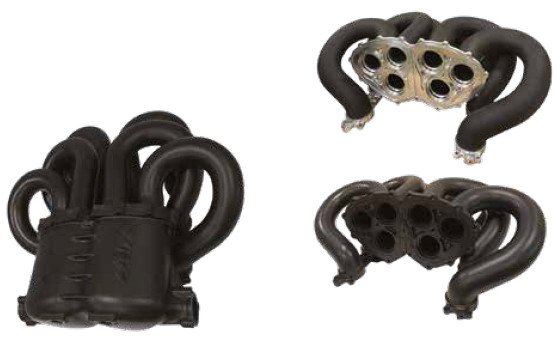
For design engineers, matching these specific material profiles to critical load paths results in direct architectural consequences: thinner walls, optimised load paths, integrated mounting features, and structural efficiency without reliability penalties.
FROM PART CONSOLIDATION TO SYSTEM INTEGRATION
The most significant opportunity additive manufacturing offers is not the part itself but the ability to rethink entire assemblies. Monolithic structures can absorb cable routing, cooling channels, mounting points, passive elements, and electronic hardware within envelopes that would defeat conventional multi-part approaches. Combined with precision CNC machining at critical interfaces, this hybrid methodology reduces assembly operations, eliminates tolerance stack-up, and compresses development cycles.

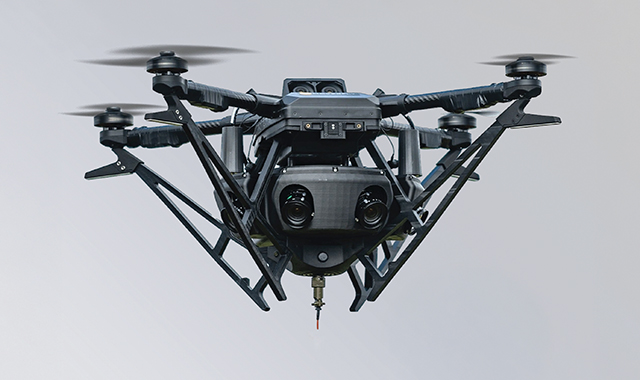
CRP Group applications across motorsport, aerospace, space, and advanced unmanned systems demonstrate the range of this approach: LRIP-qualified components operating where weight, reliability, and performance are non-negotiable design constraints—not targets to be traded against each other.
UNLOCKING CONVENTIONAL PRODUCTION LIMITS FROM PHASE ZERO
The challenge is no longer whether additive manufacturing works, but identifying where it can replace complex assemblies, reduce weight and accelerate development cycles in real production programmes.
Laura Fabbi is at CRP Group. www.crp-group.com/integrated-manufacturing-defense