Industrial facilities do not always operate within the neat boundaries of a single plant. Pumps, tanks, reservoirs and other critical assets can be dispersed over hundreds of kilometres, particularly across mining, water and utility operations. Here, Ian Loudon, international sales and marketing manager at remote monitoring specialist Omniflex, looks at the challenges this creates and how wireless telemetry can extend industrial control to remote assets and turn them into active parts of a wider operational network.
When equipment is spread across large distances, conventional cabling can quickly become impractical. The cost and complexity of installing cable across difficult terrain can make it difficult to justify, while the work involved in installing and maintaining physical infrastructure can add significant time and workload to a project.
There is also an operational consideration. Remote assets still need to be monitored, even when they are difficult or time-consuming to reach. A pump trip, changing tank level or other faults may require someone to travel to the site before the problem can be assessed, adding time to what would otherwise be a straightforward response. For applications where water or other resources are being moved between remote locations, a lack of visibility means an issue is only identified once it has begun to affect the wider process.
Wireless telemetry provides a way to address this, connecting equipment that would otherwise be difficult to incorporate into a control network. Rather than treating remote assets as isolated pieces of equipment, telemetry can provide a way of bringing their information and, where appropriate, their control functions into the wider operation.
For example, at a mine application in Zimbabwe, a large water storage tank was located around 7km from the pumps supplying it. Wireless telemetry allowed the tank level to be monitored remotely, with high and low set points used to control the pumps automatically. When the tank reached the upper level, the pumps stopped; when the level fell to the lower set point, they started again.
The tank level therefore becomes part of the control process, with the information being used to trigger a defined response when required. Routine control can take place without relying on someone being physically present at the tank.
This is not just monitoring the tank from a distance but using the information, if needed, to trigger a defined response, allowing routine control to take place without relying on someone being physically present at the tank.
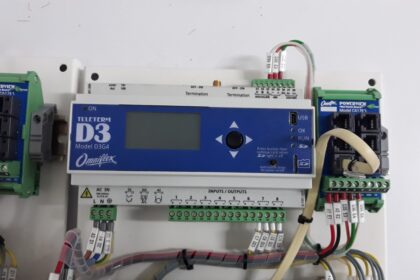
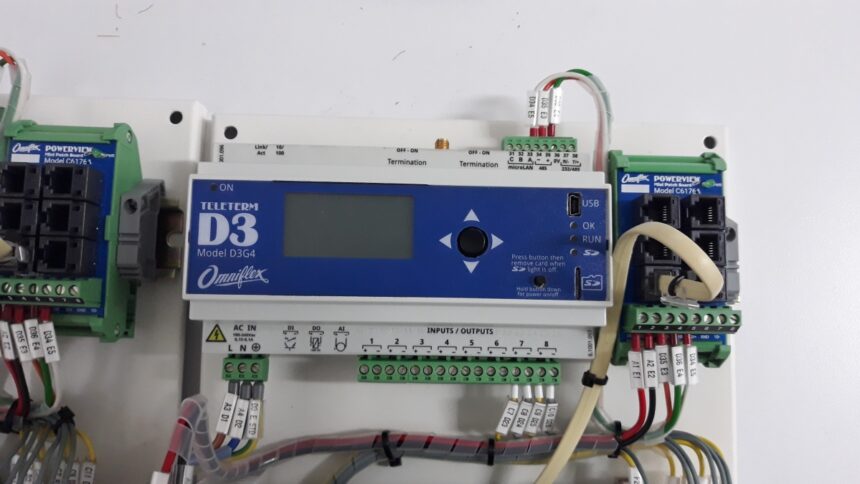
Another consideration is what information needs to be communicated. The Teleterm D3R can interface with different equipment, including power meters through a serial connection and sensors through its microLAN interface. Its wireless network can transmit information following a change of state or according to a defined time period, rather than requiring every device to be continuously polled.
As networks expand, the objective should be to make the information being transmitted as useful as possible, rather than simply connecting more assets. A pump trip or change in tank level may require an immediate response, while unchanged data may not.
The wider network architecture also needs consideration. The D3R can connect to Ethernet, allowing wireless communications to provide a link between hard-to-reach assets and existing plant infrastructure. The D3R also has a small screen used to show key monitored local or remote parameters like reservoir percentage level at the Pump Station which makes for user-friendly telemetry outstations. This means wireless connectivity can extend an existing control architecture rather than requiring remote equipment to become a separate system.
The importance of connecting geographically dispersed assets is also reflected in guidance from the UK National Cyber Security Centre (NCSC). Its water sector worked example describes a regional utility using remote terminal units to connect reservoirs and pumping stations to a central SCADA system, while considering the operational and security implications of that connectivity.
Ultimately one of the biggest opportunities presented by wireless telemetry is that it can make physical distance less of a barrier to industrial control. Where cabling is impractical and remote assets still need to be monitored or controlled, wireless connectivity can provide the link between isolated equipment and the wider operation.
Find out more about Omniflex’s work in wireless telemetry, read the sector overview on its website.