Zero-emission maritime operations more obtainable than you thought
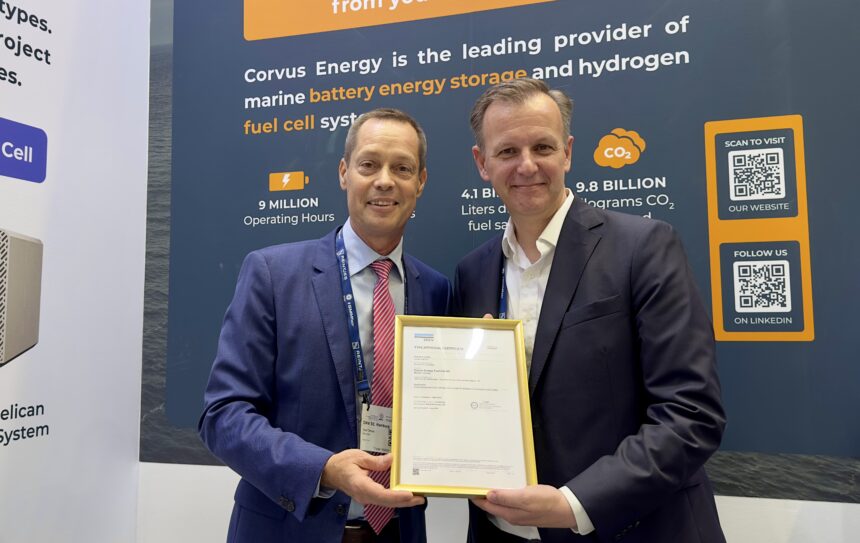
The Corvus Pelican Fuel Cell System has received Type Approval from maritime classification society Det Norske Veritas (DNV). This means it officially meets the complex safety and performance criteria required by the maritime industry.
The system was built through a three-year-long H2NOR project aiming to accelerate the development and production of maritime hydrogen fuel cell systems. It is the first fuel cell system designed specifically to be gas-safe, making it the safest fuel cell system on the market.
“It is a special fuel cell system, because the Pelican uses nitrogen for inerting of the fuel cell space,” said Olaf Drews, the head of engines and pressurized equipment maritime. “It is the first fuel cell system that uses this technology and this brings it to a very preferred safety level. This is a milestone, and we look forward to the first ship project.”
The first ship project is not far off, with the first Corvus Pelican Fuel Cell System ready for installation on board the 35m MS Skulebas, a training and fishing vessel owned by Vestland County and operated by Måløy Upper Secondary School in Norway. The vessel, which already has a one MWh battery system, will be able to last four days on zero emission.
Most vessels cannot reach zero-emission operations for long periods of time despite improvements to battery electric vessels. Vessels with longer routes or that need to charge frequently may continue to struggle unless clean fuel and fuel cells are added to enhance their zero-emission capabilities.
The blueprints of the Corvus Pelican Fuel Cell System are found in a proton exchange membrane fuel cell module from Toyota. “DNV Type Approval demonstrates that Toyota fuel cell technology is transferable to the marine sector and is a viable solution to support maritime decarbonization efforts,” said Thiebault Paquet, the vice president of Toyota Hydrogen Factory Europe.
Corvus Energy is a leading supplier of energy storage systems for maritime, offshore and port applications. The company is known for contributing to innovations such as the e-Ginny project, a 100% electric retrofit with a Corvus Energy battery. Corvus’ expertise combined with Toyota’s fuel cell technology pushed the Corvus Pelican Fuel Cell System toward its gas-safe status.
“Toyota`s unsurpassed knowledge in developing high-quality and efficient fuel cells, in addition to the strong collaboration and high level of maritime experience among the partners in this development project, has been key,” said Fredrik Witte, the CEO of Corvus Energy.
“This is a milestone for net zero shipping. We now have a high-quality range extender to add to our existing energy storage system portfolio with the scalability and the safety needed to be a real driver in the future of marine decarbonization.”