
The verdict is in and fast fashion is out, as the clothing industry’s water-intensive practices are finding a more sustainable way
The clothing industry is a notorious industrial polluter, accounting for up to 10% of global carbon emissions, according to recent fast fashion research by Uniform Market. The clothing supply chain is also water intensive. Thirsty crops and dyeing practices lead to the use of about 93 billion cubic metres of water annually.
The clothing supply chain has many steps, including but not limited to, design, material sourcing, spinning, weaving, knitting, dyeing, manufacturing, distribution and logistics. Each of these steps impacts the environment.
Since 2000, the number of new garments made annually has more than doubled and is now estimated to be around 100,000 billion garments each year. With the production and consumption of fast fashion surging, each step of the clothing supply chain also matters more now than ever.
Sustainable fibres
One way that companies are combatting the destruction caused by the clothing industry is by incorporating the development of sustainable fibres into the supply chain. Sustainable fibres are made from organic, natural and recycled materials that reduce supply chain tensions by easing reliance on water, energy and chemicals. Materials such as hemp and bamboo are often used as natural materials, but another alternative is Tencel, a regenerated cellulose fibre made from sustainably sourced wood pulp.
The Lenzing Group is an Austrian fibre specialist using cellulose as its renewable raw material to make Tencel Lyocell and Modal fibres. Lenzing produces fibres used in fashion, performance wear, home textiles and personal care products such as facial sheet masks, wet wipes and feminine care items.
Both Tencel Lyocell and Tencel Modal fibres are made with at least 50% fewer carbon emissions and water consumption than generic versions, according to the Higg Materials Sustainability Index.
The company’s cellulose fibres are made from wood harvested from forests certified by FSC or PEFC, and are produced in a closed-loop system that recovers over 99% of solvent. The recovery of solvent is a particularly important part of the clothing supply chain that is necessary to reach a zero-waste goal, according to a review of recent technologies for transforming textile waste published in Current Research in Biotechnology 2024.
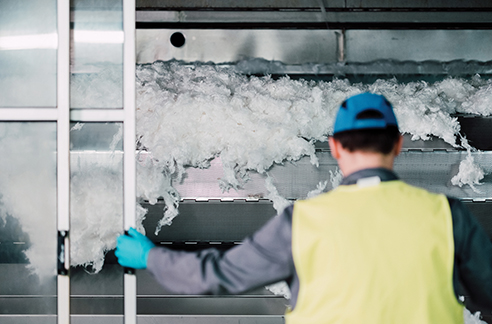
To create Tencel Lyocell fibres, wood pulp is dissolved and the solution is pumped through spinnerets to form a filament that is cut into staple fibres, which are dried, washed and pressed into bales. The fibre structure is known for high moisture regulation, thermal capabilities and reduced odour development.
The process is different for the creation of Tencel Modal fibres. For these cellulose is chemically altered and then dissolved, filtered, spun and cut into staple fibres. These fibres can withstand many wash and dry cycles, and feature high moisture regulation, high tenacity and the ability to support rich colours.
While the fibres were created to support a more sustainable process, their inclusion also impacts the quality of the final product, providing tailored options for different needs.
Better in colour
Targeting the dyeing process is another way to minimise the amount of water used in the clothing supply chain. Lenzing has its own approaches to dyeing that minimise water use that it has amassed through partnerships. However, many companies do not have the resources to arrange in-house dyeing technologies. In that case, organisations such as UK biotechnology company Colorifix become vital to the clothing supply chain.
Colorifix replaces the traditional chemical dyeing process using microbes to produce and fix pigments onto fabrics. The company works with existing industrial systems and earns royalties from the mills that sell dyed products to fashion brands.
Colorifix analyses DNA codes using online databases to determine the exact genes that produce the pigment desired. The DNA is built and inserted into the Colorifix microbe before the microbes are engineered in a fermentor. Everything in the fermentor, including the microbes, water, and residual salts and sugar, are pumped into standard dye machines with the items designated to be dyed.
The company produces the pigments, implements the bioreactors at customer sites and grow it into the dye liquid needed for dyeing locally. This minimises the need for transportation from Colorifix to customer facilities.
The most recent third-party verified life-cycle assessment performed for two different dyeing processes found there was an 80% chemical reduction and 77% less water was consumed. There was a 31% savings on CO2 emissions.
Lenzing and Colorifix are exhibiting at a London exhibition titled Performance Without Toxicity. Located at The Mills Fabrica, Kings Cross the free exhibition is running until 26th June 2026.
For more information visit: www.lenzing.com and www.colorifix.com