As hydrogen gains momentum as a low-carbon energy carrier, the challenge of storing it safely and efficiently remains a major engineering hurdle. For automotive and aerospace applications in particular, the performance of hydrogen storage tanks (HSTs) is governed by a delicate balance between weight, strength and safety
Current Type IV hydrogen storage tanks, which combine polymer liners with carbon fibre/epoxy composite overwraps, have emerged as the dominant solution for transport and aerospace applications because of their high gravimetric efficiency and lightweight construction. However, the industry continues to seek materials capable of further improving structural performance without adding mass.
A new study investigating graphene and related materials (GRMs) suggests that nanoscale reinforcement could provide a significant step forward. By evaluating several commercially available graphene materials alongside a novel microwave-assisted graphene intermediate (MGI), researchers have identified how graphene morphology, crystallinity and dispersion behaviour influence the performance of carbon fibre/epoxy laminates intended for hydrogen storage applications.
WHY GRAPHENE MATTERS FOR HYDROGEN STORAGE
Hydrogen storage tanks face demanding requirements. Hydrogen’s low volumetric energy density means tanks must withstand extremely high pressures while remaining as light as possible. Traditional engineering approaches often increase wall thickness to improve safety, but doing so adds weight, reducing gravimetric storage capacity and limiting system efficiency.

Carbon fibre/epoxy composites have already proven effective in reducing weight while maintaining structural performance. However, researchers are increasingly looking at nanoscale reinforcements to further improve fibre-matrix interactions and enhance composite performance.
Among the available options, graphene and related materials have attracted considerable attention because of their exceptional mechanical properties and hydrogen barrier characteristics. The study notes that graphene’s layered structure, large flake sizes and rippled morphology make it particularly effective at enhancing both composite strength and hydrogen barrier performance, even at concentrations below 1wt%. The challenge, however, is that not all graphene materials perform equally well.
COMPARING GRAPHENE REINFORCEMENT STRATEGIES
The research compared four graphene-based materials incorporated into carbon fibre/epoxy laminates:
- Microwave-assisted graphene intermediate (MGI)
- Bottom-up graphene material 1 (BGM1)
- Bottom-up graphene material 2 (BGM2)
- Top-down graphene material (TGM)
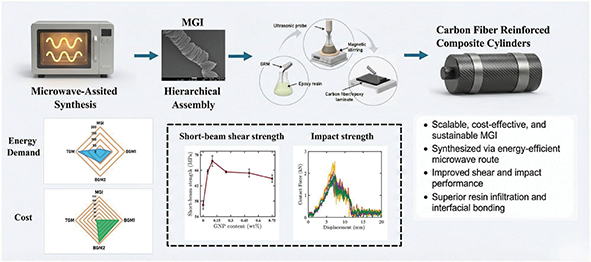
A key objective was to identify which graphene morphology delivers the greatest benefit when used as reinforcement in hydrogen storage tank structures. The researchers found that MGI possessed a distinctive expanded, worm-like structure with large flake dimensions and hierarchical porosity. Unlike conventional graphene materials, this morphology promoted resin infiltration, enhanced interfacial bonding and improved load transfer between the carbon fibres and epoxy matrix.
Morphological analysis showed that MGI featured partially exfoliated structures with average flake dimensions of approximately 32μm and interconnected pore networks extending across multiple length scales. This architecture created additional surface area while preserving structural integrity.

THE IMPORTANCE OF DISPERSION
One of the most important findings was the relationship between graphene dispersion and mechanical performance. Using Raman mapping, the researchers evaluated how evenly each graphene material dispersed throughout the epoxy matrix. Uniform dispersion proved critical because it enabled effective stress transfer and prevented localised stress concentrations.
For MGI, dispersion remained highly uniform up to a loading of 0.1wt%. Beyond this concentration, agglomeration became increasingly apparent and mechanical performance began to decline. Similar clustering effects were observed for the other graphene materials at even lower concentrations.
The study concluded that well-dispersed graphene particles strengthen the interlaminar region by bridging microcracks and improving fibre-matrix interaction. However, excessive graphene loading introduces structural irregularities that can undermine laminate performance.
SIGNIFICANT GAINS IN MECHANICAL PERFORMANCE
The most compelling results emerged during short-beam shear testing, which evaluates the quality of fibre-matrix bonding and interlaminar strength. Carbon fibre/epoxy laminates containing 0.1wt% MGI achieved the highest performance, increasing short-beam shear strength by approximately 20% compared with unmodified laminates. The resulting strength reached 68.9MPa, outperforming all other graphene variants tested. The researchers attributed these gains to the combination of effective stress transfer, enhanced interfacial bonding and the crack-bridging behaviour enabled by the MGI structure.
Structural characterisation also revealed that MGI maintained the highest sp² carbon content among all materials evaluated while exhibiting relatively low oxygen functionality and limited structural defects. This combination preserved graphene’s intrinsic mechanical properties while still providing sufficient surface activity for strong interaction with the epoxy matrix.
IMPROVED IMPACT RESISTANCE
Hydrogen storage tanks must also tolerate accidental impacts and operational damage without catastrophic failure. To evaluate damage tolerance, the research team conducted low-velocity impact testing at 20J. Once again, MGI delivered the strongest performance.
Compared with unmodified laminates, MGI-reinforced composites increased peak contact force by approximately 25% and improved energy absorption by approximately 14%. The researchers observed evidence of crack deflection, matrix plastic deformation and crack-bridging mechanisms that contributed to improved damage tolerance. These findings are particularly relevant for aerospace and transport applications, where impact resistance is a critical design consideration.
NEXT-GEN HYDROGEN STORAGE STRUCTURES
Both TOPSIS and EXPROM2 analyses independently identified MGI as the highest-performing option. Researchers concluded that its combination of large flake dimensions, preserved graphitic structure, controlled porosity and strong mechanical performance provided a clear advantage over existing commercial graphene materials.
Importantly, MGI also demonstrated the lowest energy demand and production cost among the materials studied, positioning it as a potentially scalable solution for future composite manufacturing.
The paper concludes that, as hydrogen-powered vehicles and aerospace platforms continue to evolve, graphene-reinforced carbon fibre composites may play an increasingly important role in delivering the lightweight, durable and safe storage systems required to support a hydrogen-based future.
The study ‘Microwave-assisted graphene intermediates for carbon fibre reinforced composite cylinders: achieving sustainability through state-of-the-art graphene and related materials’ is published in Materials & Design