Elemental Energies is positioning itself at the forefront of well engineering for the energy transition
Elemental Energies is positioning itself at the forefront of well engineering for the energy transition, building on decades of expertise across oil and gas, carbon capture and geothermal projects
Although new to the company, well technology manager Mike Byrne brings deep sector knowledge and a clear vision for how technical skills can accelerate low-carbon initiatives.
“I’ve been with Elemental Energies for just under two weeks,” Byrne says. “But my team and I have joined an organisation we know very well. Many of us worked together previously at Senergy Wells, which was acquired into Elemental Energies, so it’s like coming full circle. We’re new, but it feels like meeting old friends.”
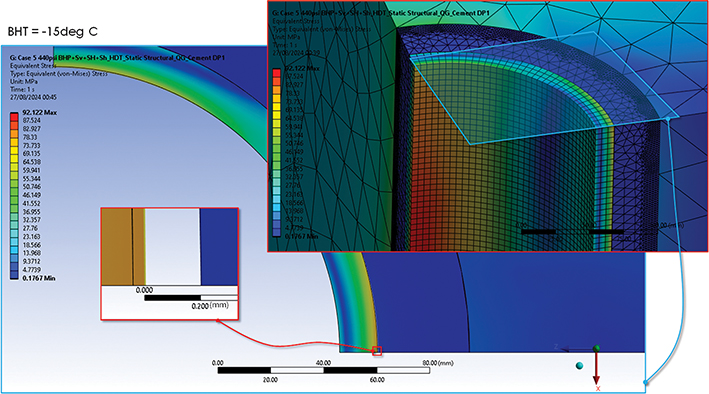
Elemental Energies’ integrated consulting model spans subsurface, production technology, facilities, and well technology. Byrne’s group provides specialist consulting support to oil and gas operators worldwide, focusing on highly technical disciplines such as geomechanics, computational fluid dynamics (CFD), and finite element analysis (FEA).
“These are very specialist processes we’ve developed over many years to support the design of new and existing developments,” Byrne explains. “We’re applying them not only to oil and gas but increasingly to carbon capture and storage (CCS).”
WELLS FOR OIL, GAS AND CARBON CAPTURE
Byrne believes one of the biggest opportunities for Elemental Energies is transferring oil and gas well expertise to CCS. “One of the messages we’re putting out there at the moment is that they’re just wells,” he says. “There’s a lot that’s the same between oil and gas wells and carbon capture wells, but there are also some things that are different and more challenging.”
He will shortly embark on a Society of Petroleum Engineers Distinguished Lecture tour titled ‘Carbon Capture and Storage Wells: The Same, but Different.’
“In oil and gas we’re dealing with hydrocarbons or water injection,” Byrne explains. “Now we’re looking at CO2, which has different properties and different challenges. But there’s actually a lot of oil and gas expertise that’s directly applicable to CCS – why people like me have transitioned into this space.”
NEW TECHNICAL CHALLENGES IN CCS
Despite the similarities, Byrne stresses that CCS brings unique technical risks. “Across the world there are two main types of CO2 storage: saline aquifers and depleted hydrocarbon fields,” he says. “Both have specific challenges.”
For saline aquifers – deep underground rock formations saturated with brine – the challenge lies in injecting CO2 without destabilising the reservoir. “We’re adding pressure into a system and need to understand what that pressure will do, where the CO2 will go, and whether precipitates or scale will form,” Byrne says.
Depleted fields pose a different set of risks. “These are at low pressure after decades of production,” he explains. “Injecting CO2 at high rates can create very high velocities, leading to erosion. CO2 is an unusual compound, its behaviour as a solid, liquid, gas or dense phase is complex. It can be useful for injection, but it presents challenges for temperature, pressure and flow assurance.”
Integrity is the biggest issue. “We’re talking about hundreds or thousands of years of containment,” Byrne says. “It’s no use injecting CO2 if it comes back to the surface in five years. We do a lot of work with geologists and geomechanics specialists to confirm that the store is sealed. Many stores also have old ‘legacy wells’ drilled decades ago which could become escape routes. Managing these vintage wells is critical.”
DECOMMISSIONING LEGACY WELLS
While Byrne’s focus is on well technology, he highlights decommissioning as a key growth area for Elemental Energies. “From a geomechanical point of view, we get involved in subsurface design for decommissioning – calculating how deep and how many plugs need to be placed so that wells are sealed forever,” he says. “Our company is involved much more extensively in the wider aspects of decommissioning. It’s vital work, even if it’s not glamorous. There are thousands of wells to decommission in the UK alone.”
He notes that Norway is now looking to the UK as a model. “I was in Norway last week,” Byrne says. “They’re starting to become more aware of the decommissioning challenge, and it’s one area where they point to the UK and say, ‘You’re way ahead of us.’”
GEOTHERMAL: THE NEXT FRONTIER
Elemental Energies is also eyeing opportunities in geothermal wells. “It’s an area where we see significant potential for growth and improvement,” Byrne says. “There are a lot of deep geothermal wells that haven’t had the engineering attention they deserve. The geothermal industry has had a failure rate of 40–50% for drilled wells – unacceptable in oil and gas. We can bring considered engineering to improve that success rate.”
SHIFTING INDUSTRY DYNAMICS
Beyond the technical aspects, Byrne sees a changing relationship between operators and the service sector. “Many of the big oil and gas companies we once thought of as impenetrable – Total, Shell, ExxonMobil – are now looking outward for specialist expertise,” he says. “That’s why Elemental Energies was built: to mirror the technical capabilities of the large operators so they can outsource entire work scopes if needed. We’re already seeing this shift happen, especially in large-scale decommissioning projects.”
A SKILLS CHALLENGE AND AN OPPORTUNITY
Byrne warns of a looming skills shortage across oil and gas, CCS, and geothermal. “Oil and gas isn’t as attractive to graduates as it used to be,” he says. “But there’s a big future in these industries. If you don’t have the skills, it doesn’t matter what your ambition is, you can’t deliver it. This is a really challenging, interesting area, especially with all the new technologies and disciplines emerging. We need young people to join.”
For Byrne, the excitement lies in applying proven engineering tools to new problems. “Carbon capture presents new challenges. If you’re surrounded by people who are good at problem-solving, who enjoy modelling and engineering, it’s the perfect situation. Even at my level of experience, it’s a chance to learn new things.”