Research shows potential in the next 10 years
Amidst the automotive industry's ever-growing pressure to become more sustainable, IDTechEx has explored how plastics can become more sustainable within the sector. Material choice is a large factor in sustainability, as currently over 14 million tonnes of plastics are used in passenger automotive vehicles per year.
The first major area for the industry is material sourcing and choice. This focuses on the front end of a conventional linear lifecycle of plastics and polymer-based materials. The automotive industry almost exclusively uses plastics from petrochemical feedstocks, creating a high carbon emission from this process.
Reliance on the petrochemical industry has more concerns, including price fluctuations, geopolitical considerations, and subsidising of the oil industry. It is not just an issue of carbon emissions.
The automotive sector is facing pressure from new regulations, including recycled content mandates and carbon taxes, which have been brought in due to sustainability concerns.
Recycled plastics and bioplastics are a feasible alternative to using petrochemical polymers. In order for these alternatives to be adopted on a large scale, collaboration across the industry will be required from key stakeholders.
Key challenges include material availability, variable material properties, and costs. Depending on the polymer and application, the situation can change drastically. Introducing recycled content in materials such as mono-material polypropylene interior components is relatively straightforward.
The issues come with more specialised components from less widely utilised polymers, as alternatives are harder to source, and in some composites, provide more difficult end-of-life challenges. This makes its more difficult for the industry to transition.
Recycling plastics mechanically is the most widely available of these materials and is currently in use by automakers within vehicles, be it at a limited extent. The process involves shredding, melting, and reforming without alternating the chemistry of the material.
EU regulations state up to 25% of materials in vehicles must be recycled. These are more likely to be from mechanically recycled plastics. Chemical recycling plastics is another feasible alternative.
Chemical recycling involves breaking plastics down into monomers or raw materials, restoring the material properties and allowing them to be reused. There are far more challenges to recycling in this manner, as the industry is much more nascent.
Using bioplastics in the future will depend on how the market grows. The material is derived from bio-based feedstocks, with adoption currently being in a limited supply. The bioplastic market is a nascent, and limited only a limited range of polymers is possible from a bioplastic source. Using this alternative also has increased implementation costs.
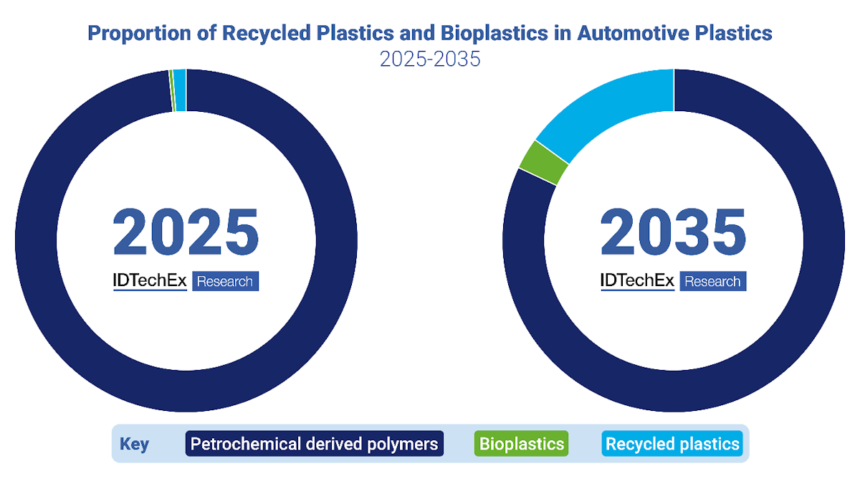
Both recycled plastics and bioplastics are expected to be used more as the markets grow, with CAGRs for recycled content standing at 29.1% and 25.1% respectively between 2025 and 2035.
Automakers have set ambitious targets for themselves over the next ten years, with aims to become more sustainable. The forecast for sustainable polymer-based materials shows car companies will up take alternative methods, but at 18%, it will be below stated targets in 2035.