Supercapacitors have higher power density and lower energy density than batteries
Supercapacitors are energy storage devices with distinct properties compared to batteries; they have higher power density but lower energy density. Supercapacitors also have a longer cycle life, in the tens of thousands, allowing them to undergo frequent charge-discharge cycles without degradation and enabling them to perform in applications where batteries are not appropriate.
A recent report from IDTechEx, titled “Supercapacitors 2026-2036: Technologies, Applications, and Forecasts,” covers supercapacitors in detail.
Supercapacitors' high power density and low energy density make them suited to applications requiring high power and low capacity. However, capacitors provide even higher power at the cost of capacity in comparison to supercapacitors, meaning the niche for supercapacitors falls between batteries and capacitors, high-power applications that require moderate capacity.
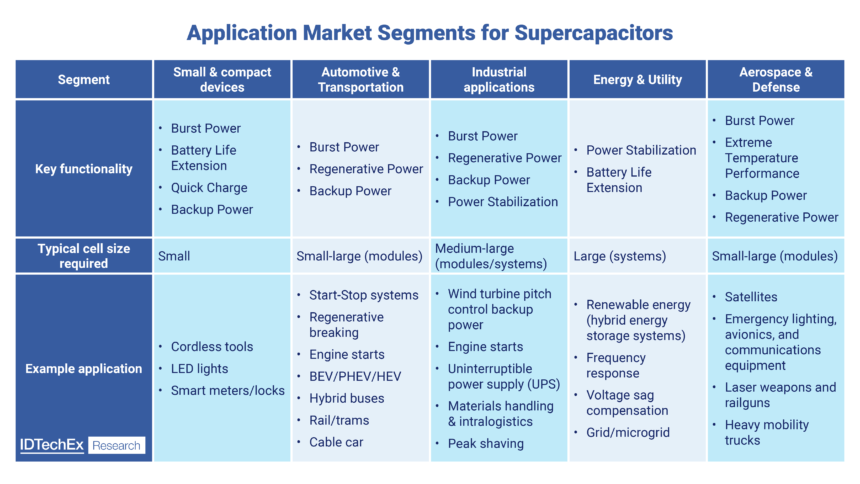
Supercapacitors are suitable for:
- Small and compact devices: Supercapacitors can be used in cordless tools, smart meters, and LED lights to enable burst power, quick charging, and extend battery life.
- Automotive and transportation: In hybrid cars, regenerative braking can quickly charge supercapacitors, thereby extending range. For electric trains and buses, supercapacitors enable burst power, engine starting, and start-stop systems.
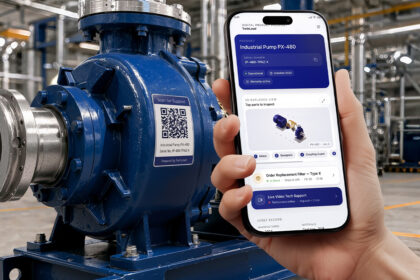
- Industrial applications: Supercapacitors have various applications in industry, including uninterruptible power supply, which is vital for semiconductor manufacturing in data centres. Logistics robots can utilise supercapacitors, with frequent charge-discharge cycles.
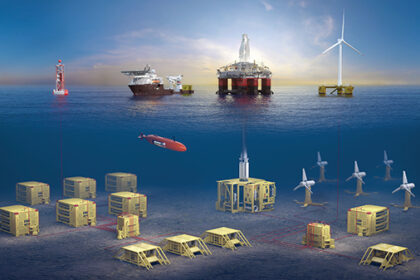
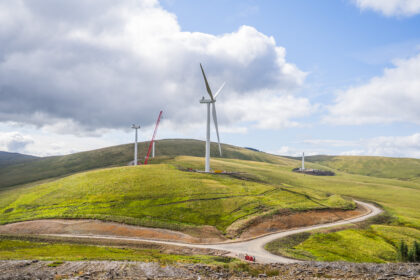
- Energy and utility: Supercapacitors can be used for energy storage, such as voltage sag compensation, power stabilisation, and frequency response. They can also be used in renewable energy and hybrid deployments with batteries, as supercapacitors extend battery life by reducing battery power demand.
- Aerospace and defense: Supercapacitors can be used in applications such as satellites, laser weapons, emergency equipment, and heavy-duty mobility trucks, as they provide burst power, regenerative power, and extreme-temperature performance.
Traditionally, the automotive sector has been the largest consumer of supercapacitors, driven by applications in hybrid cars. Regenerative braking enables rapid charging of a supercapacitor, and the supercapacitor's burst power helps with fast acceleration.
However, as hybrid vehicles are phased out and replaced by pure electric vehicles, the niche for supercapacitors in the automotive sector will be reduced. Instead, the energy sector will take over as the primary application market, driven by growing renewables and the need for power stabilization in grid and microgrid applications. IDTechEx predicts that this sector offers the greatest growth potential for supercapacitors over the next decade.
While the niche for supercapacitors is smaller than that of batteries, supercapacitors can flourish in high-power, short-duration applications.