Researchers from the Department of Electrical and Computer Engineering at Duke University are exploring the concept of topology imprinting in nonlinear metasurfaces, as a route to next-generation photonics platforms.
The new concept enables replication and manipulation of structured light fields while preserving their topological characteristics across new frequencies. In the IEEE study ‘Photonics breakthroughs 2025: Topology-imprinting nonlinear metasurfaces’, the Duke researchers review the current limitations and future research directions, hailing it as “key for next-generation photonic platforms” and their potential impact in various fields.
Light is traditionally described by properties such as wavelength, amplitude, phase, and polarisation. Advances in optics have shown that light can also be shaped into complex spatial patterns known as structured light, enabling new ways to carry information and interact with matter for applications in imaging, optical communications, and information processing.
However, generating structured light at different wavelengths with conventional optical methods remains challenging. Nonlinear optics and metasurfaces enable the precise control of light at the nanoscale, though designing metasurfaces that operate efficiently across both fundamental and harmonic frequencies remains difficult.
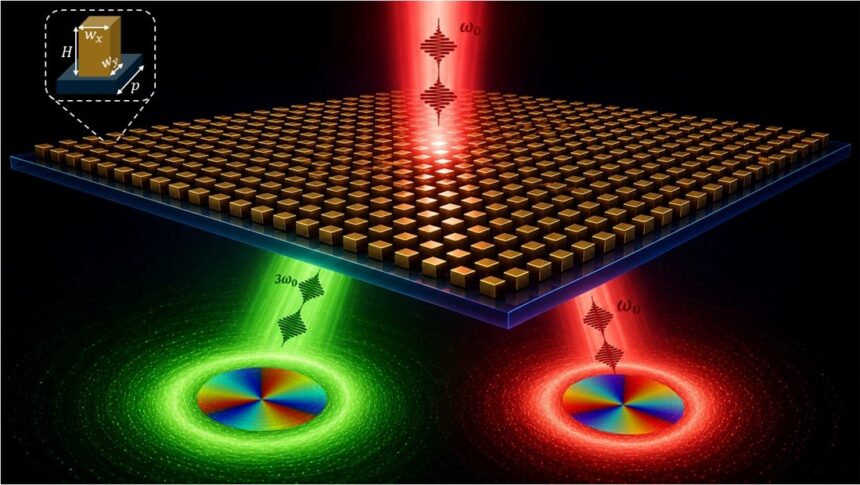
“In topology imprinting, the spatial topology of an optical field at the fundamental frequency is directly transferred to the generated harmonic radiation, offering a new way for generating structured light while overcoming material and nanofabrication constraints,” said Dr. Natalia Litchinitser, co-author of the paper.
The study discusses the physical mechanisms underlying topology imprinting and highlights key experimental demonstrations.
The concept has been experimentally realised using all-dielectric metasurfaces composed of subwavelength resonators. Various structured optical fields have been generated and preserved using this approach, including optical vortex beams carrying orbital angular momentum and optical Hopf links. A notable demonstration is the third-harmonic generation of vortex beams that preserve the spatial topology of the fundamental beam, an ability that is difficult to achieve using conventional approaches.
In terms of current challenges, the study highlights the relatively low efficiency of nonlinear frequency conversion in ultrathin metasurfaces, limitations imposed by available nonlinear materials, and the difficulties associated with scaling and integrating into on-chip photonic platforms.
Despite this, the study identifies several promising research directions, including the development of low-loss, highly nonlinear materials. The researchers also see potential to incorporate active and tunable functionalities into the metasurface designs, as well as the advantages of machine learning to optimise device performance.
Litchinitser added: “Nonlinear topology imprinting can pave the way towards compact photonic platforms capable of generating complex structured light fields, and can impact a wide range of fields, including holography, optical communications, quantum photonics, and advanced imaging systems.”