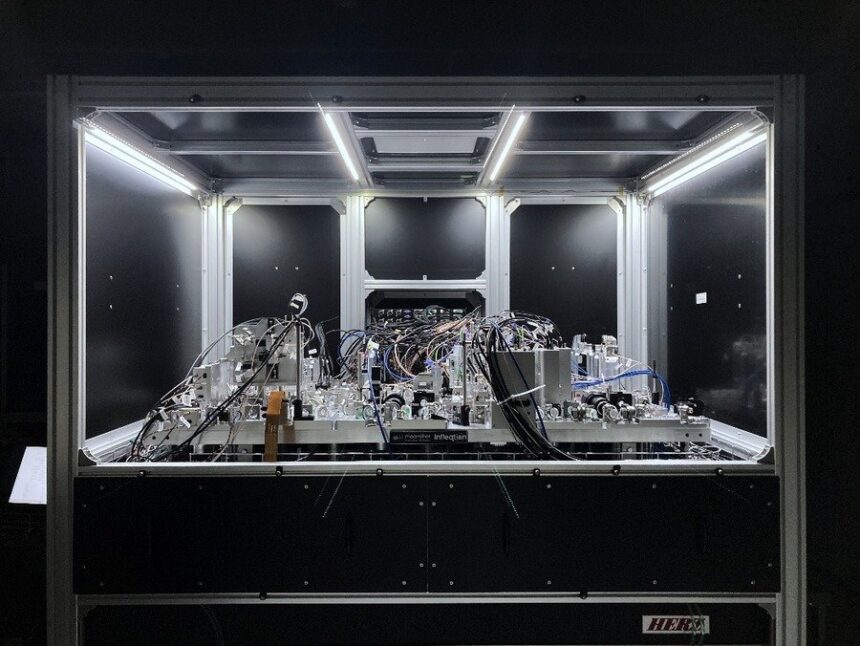
US quantum technology company Infleqtion has contributed its quantum processing unit (QPU) to “Shunkai”, a new full-stack neutral-atom quantum computer developed through Japan’s Quantum Moonshot programme.
The system, developed by a research team led by Professor Kenji Ohmori at the Institute for Molecular Science (IMS), is Japan’s first operational full-stack neutral-atom quantum computer. Infleqtion was the only foreign quantum partner selected by the Japan Science and Technology Agency (JST) for the programme.
Initially expected to operate with approximately 50 qubits, Shunkai is designed to scale to around 500 qubits as development progresses. Infleqtion’s QPU was integrated in collaboration with the Ohmori group as the project moves from research and development towards an operational quantum computing platform.
“This milestone marks a pivotal moment for Japan’s quantum ambitions as well as Infleqtion’s role in advancing production-ready quantum platforms at scale,” said Pranav Gokhale, CTO at Infleqtion. “Bringing a full-stack quantum system into production operation is a meaningful step toward fault-tolerant quantum computing that also serves as strong validation of neutral-atom architecture. Our quantum processing unit delivers the programmability, scalability and fidelity control that next-generation systems demand.”
The next phase of the Ohmori Moonshot project, which began in April 2026, will focus on improving system integration, stability and scalability. The longer-term objective is a high-performance neutral-atom fault-tolerant quantum computer incorporating up to 10,000 physical qubits alongside quantum error detection and correction capabilities.
Neutral-atom architectures use individually controlled atoms as quantum bits, offering a potential route to scaling quantum processors while maintaining precise control of qubit states. For engineering teams, the Shunkai project therefore provides a platform for addressing not only qubit count, but also the integration and operational challenges associated with larger quantum systems.
The system is also expected to become available to external users, supporting application development and research into quantum error correction across academia and industry.
The milestone represents a transition from experimental quantum hardware towards an integrated computing platform, with future development centred on scaling, stability and fault-tolerant operation.