
A new concept from Warwick researchers could help solve one of the biggest challenges to building large-scale quantum computers: enabling communication between large numbers of quantum bits (qubits) over long distances across a single chip
Published in APL Quantum, researchers from The University of Warwick and NRC Canada shared the concept of Quantum Phononic Links (QPLs), a new approach to communication between qubits. It utilises sound-like vibrations travelling through a specially designed material to carry quantum information between qubits that are physically far apart.
Currently, quantum chips only enable neighbouring qubits to directly talk to each other. To develop useful quantum computers, engineers expect to need to coordinate millions of qubits across an entire semiconductor chip, not just clusters of adjacent ones. The researcher’s approach to use sound vibrations (phonons) as an inherent communication system can enable qubits to exchange quantum information over greater distances than what is currently possible.
Dr Maksym Myronov, Department of Physics, University of Warwick, said, “One of the key challenges in quantum computing is long-range qubit connectivity. Our work introduces a new concept in which phonons act as a quantum bus, enabling distant qubits to exchange quantum information while remaining fully compatible with semiconductor technology.”
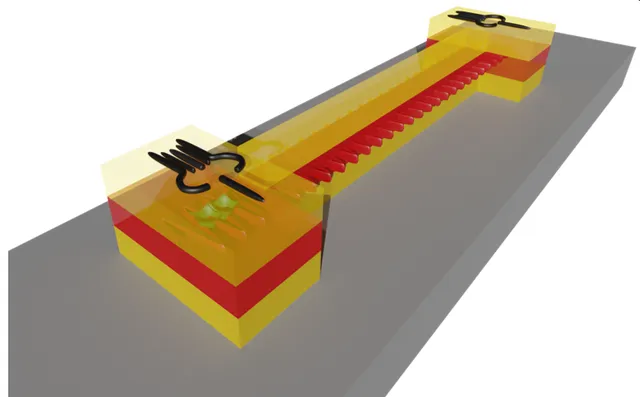
The concept is dependent on a specialised material, compressively strained germanium on silicon (cs-GoS), developed at Warwick using advanced epitaxial growth techniques. Qubits are especially sensitive to tiny vibrations passing through the thin germanium crystal layer in this material.
The researchers show that, in principle, by carefully engineering and controlling those vibrations, quantum information could be transferred between qubits whether they sit side by side or are separated across a semiconductor chip.
Other approaches to long-range qubit connections have used microwaves or externally generated surface acoustic waves, often requiring complex designs and extra hardware attached to the chip.
In contrast, QPLs are built into the semiconductor material that hosts the qubits. As the approach is compatible with established semiconductor manufacturing techniques, it could provide a more compact, affordable, and scalable route to future commercial quantum processors.