Today’s production demands more flexibility, greater precision, and higher speed
Traditional conveyor systems have served the manufacturing industry for decades; however, today’s production demands more flexibility, greater precision, and higher speed than conventional transport mechanisms can deliver
Mark Richards, UK sales manager at Beckhoff, an automation and control specialist, explains why it is time to consider alternative production line options:
Modern manufacturing
Customisation, varying batch sizes, and rapid changeovers are considered the norm in modern manufacturing. Flexibility is also becoming increasingly important, so production speed must increase to prevent bottlenecks.
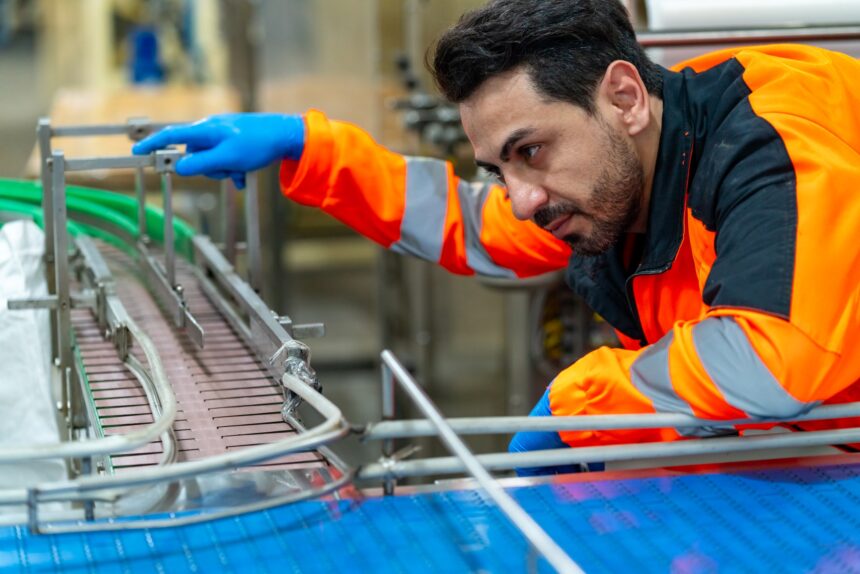
Conventional transport systems are designed to move items from A to B in a linear, rigid, mechanical fashion. To increase speed or directionality, multiple conveyors need to be placed in series, which increases the machine footprint and takes up more floor space.
Significant mechanical reconfigurations would be required to accommodate new product types or process changes, increasing downtime. The problem is even more apparent in industries where precision and cleanliness are non-negotiable.
Sector-specific strain
In semiconductor production, micron-level handling and ultra-clean, dust-free environments are standard practice. Vibrations and inconsistent speeds from traditional systems pose a real risk of damaging delicate wafers, where every physical contact point is a liability. Belts and chains are a mismatch to the demands of next-generation chipmaking.
In battery manufacturing, there are issues of weight, safety, and scalability. Battery cells and modules can be heavy and fragile, often requiring precise positioning during processes such as welding and assembly. A consistently reliable level of control is needed for safe handling, but conventional conveyors struggle to provide it. High throughput and proper traceability are requirements for the battery industry as pressure builds on EV supply chains.
In sectors like medical devices, where product formats vary widely, operations are expected to run smoothly despite frequent changes. Whether they’re therapeutic or diagnostic devices, flexibility while complying with strict regulations is essential. This makes it difficult to justify the use of rigid mechanical transport systems that introduce unnecessary complexity into what should be a responsive, adaptive process.
Intelligent motion solutions
With PC-based control, new production possibilities can be realised, and with modular automation technology, operations can change even without the flick of a switch.
Beckhoff offers software-defined transport systems that bring motion control into the digital age. XPlanar utilises planar tiles and contactless, levitating movers to achieve omnidirectional motion without mechanical abrasion. This enables products to move in any direction, tilt, rotate, or float in clean and sensitive environments. Helping create adaptive production lines where layouts and process steps can be redefined using software.
XTS combines the benefits of rotary and linear drive systems into an ultra-fast, intelligent linear transport solution. Movers glide along a continuous track with individually programmable motion profiles that can perform micro adjustments to adapt to spatial variability. XTS is suitable for high-throughput environments and can enable continuous product flow by adjusting parameters in software in real-time.