Growing demand for electrical infrastructure and semiconductor manufacturing is increasing the need to manage sulfur hexafluoride (SF6) emissions
Researchers from Jeonbuk National University have designed and evaluated a process that could use desalination brine to make SF6 treatment more economically viable. Through process simulations, they demonstrated that producing treatment chemicals from brine, recovering valuable products and reusing heat could generate enough revenue to exceed estimated treatment costs.
Behind the electric grid upgrades driven by AI and the electrification of transport lies an environmental concern: SF6. This extremely potent greenhouse gas is used in high-voltage electrical equipment for its insulating properties and in semiconductor manufacturing as an etching gas. It can trap about 24,300 times more heat than the same amount of CO2 over 100 years. SF6 is an extremely stable gas that can remain in the atmosphere for nearly 3,000 years, meaning capturing and properly treating it before release is critical to prevent long-term environmental damage.
SF6 is mainly treated through high-temperature incineration, followed by chemical treatment of the resulting gases. Researchers led by Assistant Professor Sunghyun Cho at the School of Chemical Engineering at Jeonbuk National University, South Korea, have demonstrated how integrating SF6 treatment with desalination brine processing could enable the recovery of valuable chemicals and improve the economics of the treatment process.
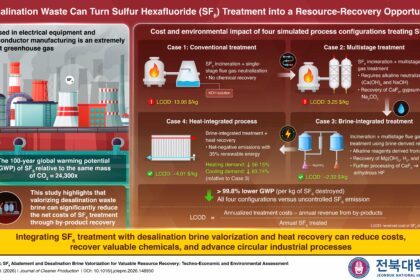
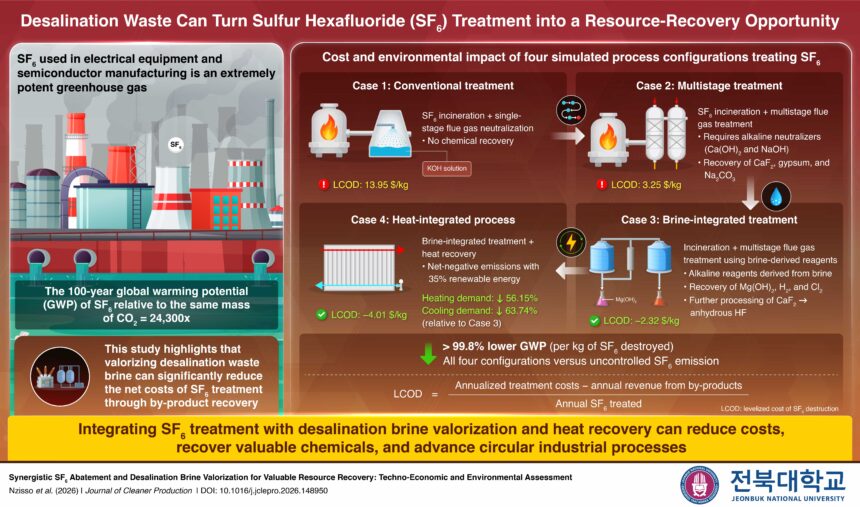
The researchers designed and simulated four process configurations for treating 250kg of SF6 per hour and evaluated their economic and environmental performance.
Dr Cho said, “The results show that an integrated process can simultaneously address two environmental challenges: sulfur hexafluoride emissions and waste brine generated from seawater desalination.”
This paper was made available online on July 20, 2026, and was published in Volume 573 of the Journal of Cleaner Production on August 2, 2026.
The first configuration used conventional incineration followed by a single chemical scrubbing stage. The second introduced multiple treatment stages to capture and recover useful salts, including calcium fluoride, gypsum, and sodium carbonate. The third used processed desalination brine to produce the chemicals needed for SF6 treatment and enabled the recovery of additional products, including magnesium hydroxide, hydrogen, and chlorine. The fourth configuration expanded on the third approach by incorporating a heat-exchange network to recover and reuse heat within the process.
The economic analysis, which compared annual SF6 treatment costs with revenues from recovered products, showed that integrating desalination brine processing could generate enough revenue to offset treatment costs.
Conventional treatment had a levelised cost of $13.95 per kg of SF6 destroyed, which fell to $3.25 per kg with multiple scrubbing stages. Processing desalination brine to produce treatment chemicals and recover additional valuable products reduced the cost to -$2.32 per kg. This negative value indicates that the revenue from recovered products exceeded the estimated annualised treatment costs. A heat-recovery system further improved the result, bringing the cost to -$4.01 per kg while reducing heating and cooling demands by 56.15% and 63.74%, respectively.
The life cycle assessment revealed that all four configurations reduced the global warming impact by more than 99.8% compared with releasing SF6 directly into the atmosphere. The heat-integrated system also achieved net-negative emissions when powered by an electricity mix containing 35% renewable energy.
The evaluations demonstrate how turning desalination waste into a resource could make SF6 treatment more economically and environmentally sustainable.
Dr Cho said, “Rather than treating greenhouse gas emissions and saline wastewater as separate environmental problems, the proposed system offers a practical framework for integrating waste treatment, resource recovery, and chemical production within a circular industrial network.”