The two car titans have agreed to come together to research and create technologies for next-generation SDV platform development
Nissan and Honda have announced the two companies will come together to carry out joint research on the area of platforms surrounding next-generation software-defined vehicles (SDVs). The two companies have signed a memorandum of understanding (MoU) to discuss intelligence and electrification in partnership.
Another MOU was signed to deepen the framework of strategic partnership.
With a common goal of reaching carbon neutrality, Nissan and Honda are looking at collaborating in various fields which may also create a traffic and accident-free driving experience. Both companies are investing heavily in R&D to accelerate the evolution of electric vehicles (EVs) and especially SDVs.
The companies believe technology innovation is extremely rapid in the software field, which is responsible for autonomous driving and AI. By combining in a partnership, the companies believe this can be achieved quicker through the pooling of technological knowledge and human resources.
Nissan and Honda have entered into a joint research agreement on fundamental technologies for the next-generation SDV platform. They believe this will create new value through co-creation.
Having identified the next-generation SDV platform as a cornerstone technology, the two companies are aiming to complete basic research in a year. Based on the results, Nissan and Honda will consider mass production development.
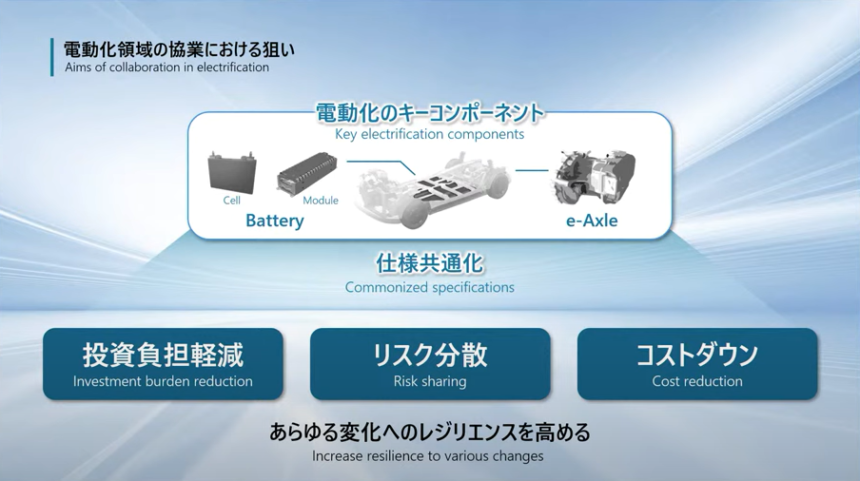
The companies will share specifications and mutual supply of short-term, medium and long-term EV batteries. By combining, the companies can ensure they are offering a wide range of options, diversifying its portfolios and being able to supply large volumes.
Agreement has been made to share specifications on battery cell modules for EVs, on a medium to long-term basis. The aim is to have communised batteries, allowing any batteries procured to be usable in vehicles from both companies. They will also study the supply of lithium-ion batteries for EV manufacturing. These are being produced by L-H Battery Company which is a joint venture between Honda and LG Energy Solutions.
E-Axles will also be communised by the two companies over a medium to long-term basis, to be used in the next generation on EVs. Motors and inverters will be shared first, as they are the core of the e-Axle.
A product review system will be implemented by both companies. This is so the two companies can review how to complement each other's EVs on sale in each region. ICE and EVs are being considered for mutual complementation on a long-term basis, with the two companies agreeing to supplementing on a short-term basis.
Within Japan, the companies have agreed to investigate the possibility of cooperation in the areas of energy services and resource circulation. This will include charging, energy equipment, energy services utilising batteries and charging services.