
Winners of the Water Breakthrough challenge receive £42.7m
Regulatory body Ofwat has announced winners of the Ofwat Innovation Fund’s Water Breakthrough Challenge. The winning companies and projects will solve challenges faced by the industry and will benefit from £42.7m in funds.
The projects will see water companies working with 70 partners including research universities, engineering powerhouses, environmental charities and NASA.
Between 2020 and 2030 the Ofwat Innovation Fund is investing £600m in innovative projects and technologies to benefit the “environment, society and customers,” according to the organistion.
The winning projects are required to put up at least an additional 10% themselves, taking the total value of money going into the scheme to £48.8m. Winners are required to openly share the lessons learnt from funded projects openly to ensure progress can be built upon by all water companies.
And the money went to…
A collaboration called Space Eye has received £1.3m for a project that promises to transform the use of satellite technology for the water industry. The project will include the design, launch and operation of micro-satellites to provide imaging of the UK’s water pipe network.
Machine-learning algorithms will enable Space Eye to quickly locate leaks in pipes that become visible by rising to the surface, identify water wastage from unauthorised or unnecessary water use, and analyse surface water to check whether harmful chemicals are impacting water quality, to help water companies fix problems quickly, resulting in fewer delays for customers affected by water supply issues and minimising disruption.
The project will see five water companies in England and Wales, led by South Staffordshire Water, team up with US micro-satellite experts Quub, the University of Wolverhampton, Scottish Water and Spring – the centre of excellence for water sector innovation.
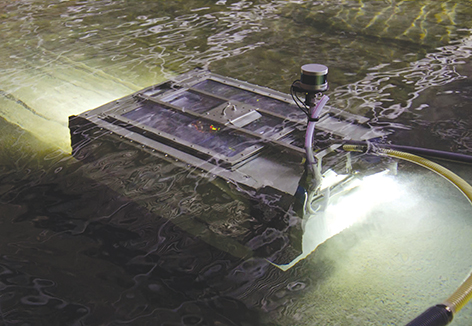
Another project called Sandscape, a collaboration between four water companies, led by Thames Water, has been awarded £2m to test at full scale tank-like robots (up to five metres in length) that make chemical-free ‘slow sand filtration’ more efficient. Slow sand filtration is a highly effective, nature-based solution for cleaning water, but has a built-in inefficiency because of the need to regularly stop and drain the sand filters of water to remove the sand layer containing the particles captured when making the water fit to drink.
A third project titled Smart Skies, Healthy Waters has been awarded £6m for a solution that will create a ‘drone- and lab-in-a-box’ that provides on-site results and lab-grade analysis of coastal bathing water quality.Using automated drones, robotics and cutting-edge sampling techniques, Smart Skies, Healthy Waters aims to improve coastal water monitoring. This capability will significantly increase the monitoring and sampling frequency as well as the delivery of results, cutting the time from up to three days to a matter of minutes, meaning customers can access near live updates on bathing-water quality rather than having to wait. Northumbrian Water will work with Newcastle University, drone experts Skyports Drone Services, real-time sensor specialists Proteus Instrument and data experts Makutu Dot IO.