Heat Island effect can be counteracted by the use of canopies
Urban islands can fall victim to the urban heat island effect, which is when a city experiences higher temperatures than nearby rural areas. This raises energy consumption in the city as well as air pollution and creates public health concerns.
Natural land cover is replaced by buildings and infrastructure in the urbanisation process, leading to buildings absorbing and retaining heat which can cause a potential 3 degrees Celsius rise in temperatures when compared to local rural areas.
Pull-wound manufactured canopies offer a solution without excessive finances, materials or time required. Urban Canopee provides manufactured canopy systems for urban environments. Canopy systems offer similar benefits are other green infrastructure solutions.
Canopy systems are moveable scalable structures which can be retrofitted onto existing infrastructure and naturalise urban spaces through supporting climbing plants.
Limitations in material production hindered Urban Canopee’s initial products, as its first manufacturing partner had sourcing challenges according to chief technical officer and co-founder Elodie Grimoin.
Grimoin said: "Initially, we faced sourcing challenges with our plastic supplier, limiting our production capacity, however, this challenge also provided an opportunity to reassess our materials. We needed something stronger and more durable than plastic for the frame of our canopies.”
Urban Canopee found Exel Composites, a Finish composites manufacturer specialising in pull-wound composites, in its pursuit of finding a more suitable material than plastic.
Lauri Turunen, product business owner for tubes and telescoping poles at Exel Composites said: "The brief from Urban Canopee necessitated a material that could provide the perfect balance of strength, flexibility, and lightweight properties for the company’s canopy systems.”
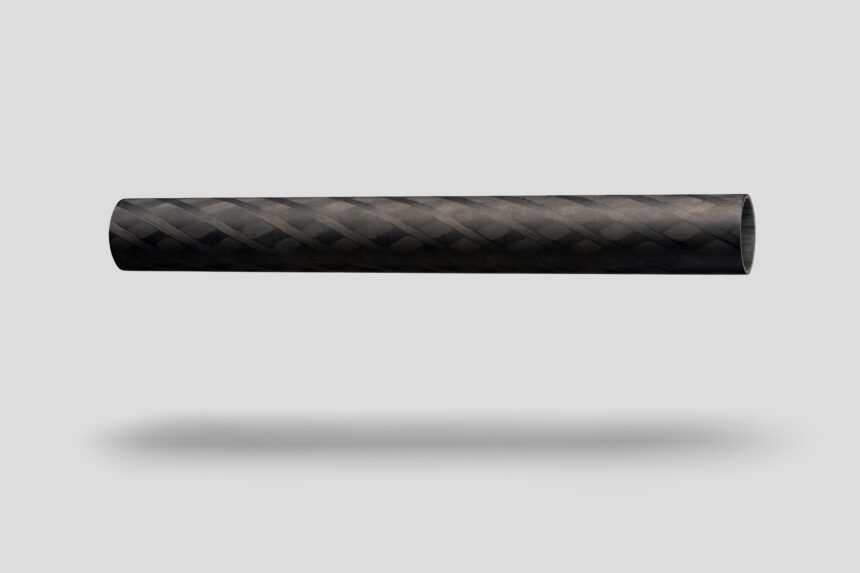
Turunen added: “Our pull-wound fibreglass composites fit these requirements by employing cross-aligned fibres, ensuring resilience against hoop stress. This is the force exerted around the circumference of the tube when it is under stress. This feature makes our tubes ideal for various applications, including canopy systems.”
Straight tubes are needed to bend with curved structures within the canopy systems. Rigidity and minimised deflection are properties of this building structure and prevent the canopy itself from deforming or bending. Flat sheet designs are burdened with this limitation.
Exel Composites customised the resin system to meet the canopy demands, making sure the tubes maintained its strength to withstand high wind loads and other environmental factors, flexible enough to conform to the curved structure and lightweight enough for structures to be moved easily.
Glass fibre composites have a tensile strength reaching up to 3033MPa, greater than aluminum’s 1600MPa or acrylic/polycarbonate plastic’s 61MPa. Density is also an important factor, as glass fibre composites have a density of 2.49g cm-3 whereas aluminum’s density is 3.63g cm-3 making it a more viable option for manoeuvring.
Pull-winding creates greater-strength tubes at much longer lengths with more uniformity when compared to plastic extrusion. Extrusion is limited in its capacity to produce uniform plastic products. Using pull-winding reduces production lead times and streamlines the process.
Translucent composite tubes could be used in the future as Urban Canopee and Exel Composites technologies advance. This would allow for lighting integration with functionality and aesthetic appeal.
Green infrastructure is another effective way of subsiding the urban heat island effect, using parks and living roofs. Central Park is the most widely known instance of this, despite not being originally built for this reason. City parks can relieve cities of air pollution and provide oxygen. The only drawback, parks are large-scale projects that require large amounts of space and investment. Fast implementation is not possible.
Cooling roofs, cool pavements and permeable pavements are some of the new advancements in urban cooling technology. Cooling roofs reflect sunlight and therefore do not absorb heat whilst cool and permeable pavements have additives reflecting solar radiation and providing runoffs.
Vertical gardens, tree planting programs and shade structures increase greenery in cities whilst reducing heat absorption, having the same impact as cooling roofs, cooling and permeable pavements. These are good options, but require large investment into infrastructure.