
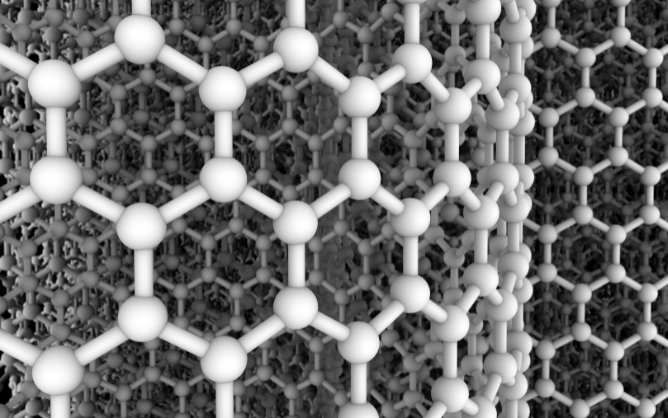
Scientists have created a single-step process to grow graphene-like films using Azupyrene
New research reveals a way to make graphene that adds structural defects, resulting in improved performance from the material, potentially leading to benefits across a variety of applications, including sensors, batteries, and electronics
Scientists from the University of Nottingham’s School of Chemistry, University of Warwick and Diamond Light Source have created a single-step process to grow graphene-like films using a molecule, Azupyrene, whose shape resembles that of the desired defect.
David Duncan, associate professor from the University of Nottingham, was one of the lead authors on the study. He said, “Our study explores a new way to make graphene. This super-thin, super-strong material is made of carbon atoms, and while perfect graphene is remarkable, it is sometimes too perfect. It interacts weakly with other materials and lacks crucial electronic properties required in the semiconductor industry."
Duncan added, “Usually, defects in material are seen as problems or mistakes that reduce performance; we have used them intentionally to add functionality. We found the defects can make the graphene more 'sticky' to other materials, making it more useful as a catalyst, as well as improving its capability of detecting different gases for use in sensors. The defects can also alter the electronic and magnetic properties of the graphene, for potential applications in the semiconductor industry.”
Graphene is made up of a flat tiling of six carbon atoms in a ring, whereas the desired defect has rings of five and seven carbon atoms. Azupyrene, which has a shape that naturally includes the same type of irregular rings, was used to grow graphene, resulting in films with a high rate of this specific defect. The amount of defects in the material can be controlled by changing the temperature during growth.
A demonstration by researchers at the Graphene Institute in Manchester saw graphene transferred onto different surfaces whilst retaining the defects, a technological achievement towards applying these films to actual devices.
The work brought together a collaboration across the UK, Germany and Sweden using microscopy and spectroscopy at Diamond Light Source in Oxfordshire, MAX IV in Sweden, and the UK national supercomputer Archer2, enabling researchers to study the defective graphene's atomic structure- indicating the defects were present and how the defects impacted the chemical and electronic properties of the defective graphene.
Professor Reinhard Maurer, Department of Chemistry, University of Warwick, said, “By carefully choosing the starting molecule and the growth conditions, we’ve shown it’s possible to grow graphene in which imperfections can be introduced in a more controlled way. We characterise the signatures of these imperfects by bringing together atomic-scale imaging, spectroscopy, and computational simulation.”
Dr Tien-Lin Lee from Diamond Light Source said, “This study is a testament to what can be achieved through international collaboration and the integration of diverse scientific expertise. By combining advanced microscopy, spectroscopy, and computational modelling across institutions in the UK, Germany, and Sweden, we were able to uncover the atomic-scale mechanisms behind defect formation in graphene, something no single technique or team could have achieved alone.”