The UK manufacturing sector could begin relying more on RLG, saving money usually spent on renewable electricity
A report commissioned by trade association Liquid Gas UK has found that businesses relying on high temperatures for industrial processes can meet their carbon reduction targets more easily using renewable liquid gas (RLG).
“The government has set out that industrial emissions must be reduced by two-thirds by 2035 and by 90% from 1990 levels by 2050 to achieve net-zero targets,” said George Webb, chief executive of Liquid Gas UK.
“However, electrification is not suited to the complexity of different processes and temperatures that require quick modulation, and businesses in this space require an alternative.”
Glass, cement and mineral sectors regularly require reaching 1,000-degree temperatures. This process can be expensive if done with a furnace powered by renewable electricity instead of RLG.
For example, the report found that a glass manufacturing facility producing 110,000t of glass each year would require a 28,000kW furnace. An electric furnace this size costs around £9,000,000 annually, as opposed to the £6,411,000 RLG furnace.
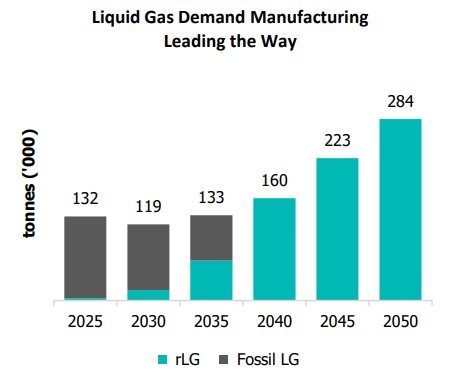
With energy costs so low, RLG-based heating system demand is expected to rise 42% to 128% from 2025 to 2050, depending on the availability of low carbon hydrogen.
“The government’s biomass strategy recognised that renewable liquid gases can contribute to decarbonising high-heat industrial processes,” said Webb.
“But we need decision-makers at all levels to join us on our journey to bring more RLGs to the market, so these hard-to-electrify sectors can play their part in reaching net-zero.”
The industrial sector’s high-heat processes and manufacturing make up 14% of UK carbon emissions.