
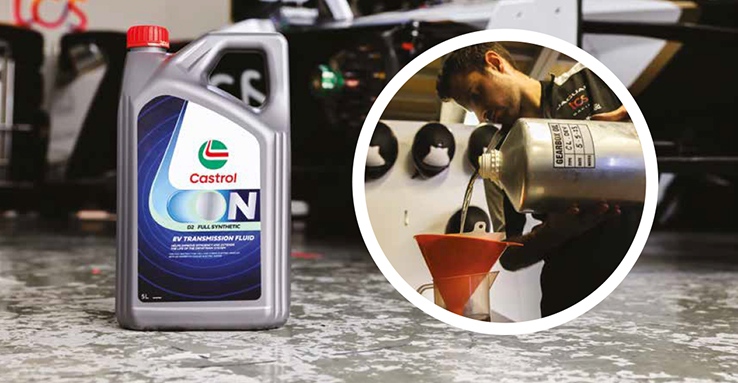
Motorsport has become a potent outlet for testing re-refined transmission fluids that support the future of EV efficiency – Siobhan Doyle speaks to one Formula E team at the forefront of this
Motorsport has become a potent outlet for testing re-refined transmission fluids that support the future of EV efficiency – Siobhan Doyle speaks to one Formula E team at the forefront of this.
The world of transport is going electric and EV fluids have a vital role to play in this transition. This is because the demands on electric vehicle (EV) transmissions are more acute than conventional transmissions, with maximum torque delivered at low speeds and the increasing integration of electric motors. Furthermore, EV transmissions are now evolving from
a separate electric motor to a combined system.
As the market’s offering of EV technology evolves, so must the industry’s testing capabilities to help support it. In fact, racing series Formula E is a testbed for British oil company Castrol which works with Jaguar TCS Racing, using their competing car, the all-electric Jaguar I-TYPE 6, as a fast-paced laboratory to trial the comparable performance of a more circular transmission fluid.
Castrol has been the racing team’s official EV fluid partner since 2019, working with the team to co-engineer advanced EV fluids and lubricants to realise the performance and sustainable solutions that can propel the efficiency of future EVs.
“The use of re-refined EV transmission fluid is a great demonstration of circularity in action on the racetrack and supports the wider company ambition to adopt circular economy principles so we can reduce the use of virgin materials,” says James Barclay, Team Principal of Jaguar TCS Racing and Managing Director of JLR Motorsport. “We have a clear aim to achieve carbon net zero by 2039 and embed sustainability into the JLR DNA.”
TESTING FLUIDS
Jack Lambert, Research and Innovation Manager at JLR Motorsport, provides further insight into the process. “Throughout Season 9 (2022-23), which was the first deployment of Formula E’s Gen3 car, we looked at this performance lubricant through a different lens to say, ‘can we do this in a more sustainable way?’,” he says. “Formula E has a tight-knit ecosystem – we [manufacturer teams] control our own cars, powertrains, our logistics, meaning everything is manageable in this small space. This allows us to accelerate the process of exploring a more sustainable approach to managing fluid.”
He adds: “We first look at the waste fluids coming out of the car, or out of the powertrain, whether that’s from race activity, test activity, or from our rigs at our factory base in Kidlington, Oxfordshire. We view this waste product as feedstock rather than something that we need to dispose of. We then, with Castrol, looked at ways to get ‘the good stuff’ out of this waste that we can use again.”
Jaguar TCS Racing has developed a process, in collaboration with Castrol, to extract the base oils from fluids already used across the team’s operations. “We use the process of distillation to remove additives that are in the transmission fluids,” he explains. “After, we are left with base oil because it has a significantly higher cut point than a lot of the other additives in the mix.”
Waste transmission fluid taken from across the team’s test and development activity is collected and re-refined by Castrol to recover its main constituent base oil. This circular base oil is then blended with performance additives to make a fresh batch of the EV transmission fluid which is then added to the Jaguar I-TYPE 6’s gearbox in place of fluid containing virgin base oil.
This process comes with a circularity-mindset, but Lambert stresses that it is not yet 100% circular as the recovered base oil only counts for a certain proportion of the waste fluid. “We are able to recover a very significant percentage of the base fluid through the re-refining process, around 89%,” he says. “Then it’s about closing the loop – once we’ve got the waste, we’ve got be able to recover the useful base oil molecules, then turn them into a formulated product that is able to go into an application.”
EV FLUID BENEFITS
Castrol is partnered with many manufacturers to ensure its lubricants deliver what EV drivers want: to go further on a single charge, enable transmission and component parts to have a longer life, and ensure the health of the battery lasts longer. For example, EV transmission fluids help reduce energy losses and extend the life of an EV drivetrain system, and help protect a vehicle’s gears. Castrol’s EV thermal fluids can also help reduce the maximum temperatures which the cell batteries reach during ultra-fast charging, indirectly cooling the system.
For Jaguar TCS Racing specifically, Lambert expresses how the team, and its partners, are always finding new ways to improve performance in their cars. “Being able to prove that you can take a performance technology in a high performance environment and pivot to a more sustainable approach without compromise, has been huge,” he says.
Jaguar TCS Racing’s partnership with Castrol has become a proof point for the wider business. “Here at JLR, we have signed with Castrol, and they will be utilising re-refined base oils, but on an industrial scale,” he adds. “We see racing at the heart of the technical development here at JLR. More of the work that we do in house and more of the work that we do with our partners, is reflected back into the business here.”
A PROVING GROUND
Both Jaguar TCS Racing and Castrol will collect key data within the contained ecosystem to develop a technical and practical understanding of the technology and processes surrounding more circular transmission fluid systems. The ultimate aim is to apply these learnings from the track to everyday road cars.
Barclay highlights how Jaguar TCS Racing is the first Formula E team to deploy this circular process and “set the standard for pioneering circularity within the paddock”. He also believes that this key discovery will help technical experts within the partnership to “learn what is possible when pushing the boundaries of EV fluids for the benefit of future road cars.”
Lambert agrees, stating that technological developments and learnings seen across the Jaguar TCS Racing team could help accelerate developments across the wider JLR business. “There are concepts that would normally live in a research space in an OEM that would take around four to five years to get to maturation ready for a road car application. We are trying to de-risk a lot of the early phases of development. The technology developments seen in Formula E, and the learnings around it, can help accelerate those early phases.”