A startup will extract subsea copper using a closed-loop system that protects the environment
Copper, also known as the red metal, is likely to see an exponential increase in demand over the next decade, according to the IEA.
The increase in demand is likely to come in large part from electric vehicles (EVs) and the batteries they contain. A similar 2024 report from analyst firm IDTechX entitled “Copper Demand for Cars 2024-2034: Trends, Utilisation, Forecasts” also predicts this rise. It explains that the demand for copper from the automotive industry was just over 3MT (1MT = 1 billion kilograms) in 2023 but is set to increase to 5MT in 2034, marking a 4.8% compound annual growth rate (CAGR).
This growth in demand continues to be driven by energy applications such as EVs, as well as storage, renewables and solar panels. For copper, the rapid expansion of grid network investment in China was the single largest factor of demand growth over the two years. Despite a slowdown in EV deployment in some markets, energy technologies continued to drive demand growth for major battery metals, contributing to some 65 to 90% of total demand growth over the past two years.
The IEA predicts that supplies of the metal will fall 30% short of the amount required by 2035 if nothing is done, analysis by the International Energy Agency predicts.
What is Green Minerals
Originally from an oil and gas background, entrepreneur Ståle Rodahl set up Green Minerals in 2020 after being informed about the considerable copper deposits in Norwegian seabed. That the Norwegian government had recently voted through a seabed minerals act (2019) gave Rodahl the green light.
The seabed comprises three types of mineable surface: nodules containing largely manganese and rare earth minerals, cobalt-rich crusts, and sea floor massive sulfides (SMS) containing copper, gold and silver. Green Minerals plan to mine this last category. “Seabed minerals are a significant copper resource, and the demand for copper doesn’t look like it’s going to ease anytime soon,” he says. Such a project is unlikely to be taken on by a traditional mining company since the environment and conditions are so different.
The team
The project has involved around 15 engineers to date, although the team expands and contracts according to need. Rodahl describes the company as “currently a small and non-revenue generating R&D company set up to assess the viability of the deep-sea minerals project”. Still in its nascent stages, the company is set to go into operation in the first-quarter 2026.
Consortium
The company relies on a consortium of companies for the technology required. This includes OSI, a company with experience of operating riser systems for Allseas/TMC nodules, and Japanese consortium SMD, a company that delivers mining machines for SMS mining projects.
Research into the project
In Norway companies don’t get a license to explore or do research, rather this is the province of academic institutions, often financed by the government which now has 20 years’ worth of research. This information is freely available and includes data on mineral deposits, weather patterns and more.
The setup
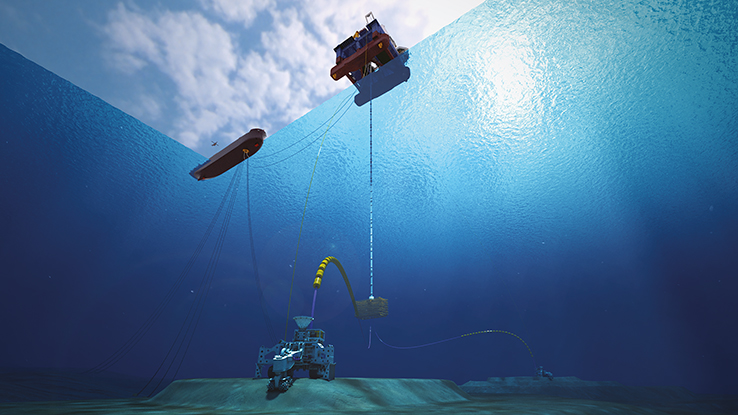
The company will operate from a semi-submersible platform for reasons of stability. Several operators will be acting as miners from a hub on this platform. A pressure exchange chamber will sit in the sea beneath; and a riser, with one line going up two lines going down sits beneath this (pulling material up to the surface, and redepositing sea water on the sea bed). The riser operates as a closed loop system. Connected to the riser is the SMD mining machine itself.
Extraction
This machine carefully targets deposits, then chews at the bottom of the sea. It features counterrotating teeth that chew inwards and a mouth that sucks up the material, then sends it via the riser to the pressure exchange chamber through the platform to a carrier vessel alongside.
How does the technology operate?
The mining equipment was validated via the 2015 project VAMOS conducted in Bosnia at a flooded open pit. This project provided requisite data on cutting, plumes, slurry and manoeuvrability of the chewing machine. The difference with the Green Minerals setup will be the significant pressure the machine faces underwater, but as Rodahl explains, modifying the machinery is easy enough. “SMD has already done this for machines going down to 4,000m, while Green Minerals will only be operating at between 1,000m and 3,000m,” he says.
In terms of speed, the riser, the system pulling the material up towards the surface, is deployed at 300m per hour, and the whole system is deployed in ten hours. “It’s so fast you can hardly believe it,” Rodahl says.
Environmental concerns
Plumes, in which debris from a mud or sandy bottom rise and join sea columns, have in the past been flagged as a potential concern for the subsea ecosystem – however this is not an issue for Green Minerals according to Rodahl since the Norwegian Continental Shelf is effectively rock. Another concern for such an operation might be how noise impacts sea life but as Rodahl explains, there are no pumps beneath the platform and the system’s noise is below the natural noise in the surrounding environment.
Plans to operate in other seas
The system has been specifically designed for the harsh Norwegian sea. The weather window for producing is around 200 days a year since wave height and lengths are higher than in other waters. A dis-connectable turret solution has been designed to deal with difficult weather. Rodahl says that operating elsewhere is perfectly possible and that the company has an MOU to operate in the Pacific, but plans to put its attention on Norway in the near term.
As of April 2025, 32 countries around the world support a ban, moratorium or precautionary pause on deep-sea mining, citing the absence of a robust regulatory framework and insufficient scientific understanding of the environmental impacts of deep-sea mining, according to the global energy watchdog the IEA. However, the extensive studies done by the Norweigian government into the impact of closed loop mining of the sort conducted by Green Minerals arguably allows such companies to explore and extract with minimal impact on the subsea environment.
For more information, visit: https://greenminerals.no