Successful prototype in-port and offshore testing has made Seaonics confident Ocean Charge can be commercialised
Seaonics has announced its Ocean Charge for offshore charging solutions. This is designed for electric SOVs. Successful in-port and offshore prototype testing has led to Seaonics being confident the solution can be commercialised.
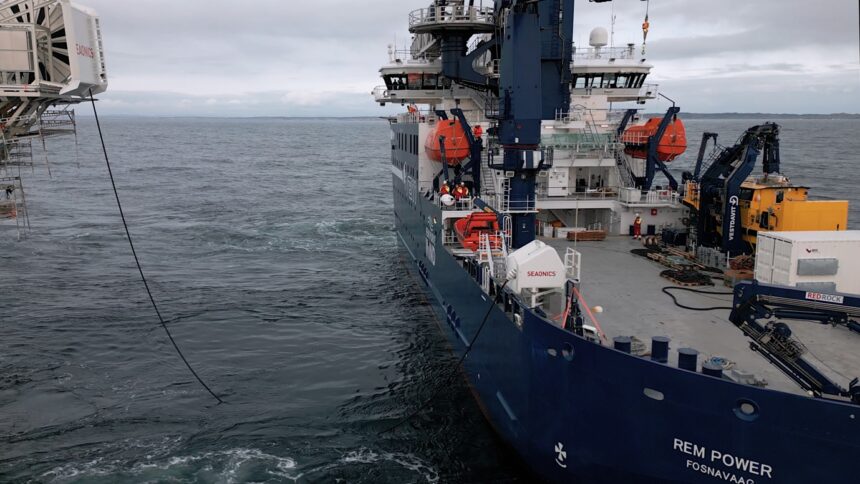
Rem offshore-owned diesel-electric hybrid CSOV (Construction Service Operation Vessel) was used in-port to test the high-voltage charging of its batteries. This was later conducted offshore from a charging point, using a cable reel, winch and control system mounted on a wind turbine.
Bjørnar Huse, sales manager of offshore energy at Seaonics, said: "At 10 years old, the turbine is one of the smallest offshore but the prototype proved it is possible to install the Ocean Charger on an existing turbine and charge an SOV from day one, using 11 kilovolt (KV) current delivering 6 MW of charge. Apart from a handful of improvement points to fix, the concept and control system are complete and the product is available for sale as is. We're first in the market and already in talks with wind farm owners."
Customisation will have to be implemented for commercial purposes, as power current varies between wind parks and wind turbines.
Shipbuilders are enabled to create zero-emissions SOVs to the offshore wind industry by being able to charge vessels offshore in a cost-effective way. No additional energy sources are required for this operation, and being able to connect ships to wind farms helps bring forward the progress of becoming zero-emissions. Diesel is still required for the ships to operate, as this is required for backup power. The amount of diesel required is significantly reduced compared to non-hybrid models. Time and energy are saved by charging at wind farms instead of returning to shipyards.
A full-day charge could be completed in three to four hours, charging at a rate of 6MW, as the average 60-person SOV consumes between 20 to 25MW per day. However, it is best to stay between 50% and 80% battery charge, as fully depleting the battery can deteriorate its lifespan. Ad-hoc charging during the day can be used to achieve this and ensure the battery never drops below 50%.
Despite mechanically being easier to install charging points on floating buoys, wind farm owners are moving away from this due to the logistics involved. Firstly, this is an expensive method requiring a high level of investment. Secondly, substations are normally owned by the grid owner instead of the wind farm owner. This creates confusion about who is responsible for maintenance and insurance for the substation, having to be accounted for on a case-by-case basis. It is much simpler to install these charging points onto the turbine.
Industry-standard connector plugs and power levels make the solution more cost-effective in its offshore charging and in-port. A vessel and crane were used in the prototype, by tying together known technologies a prototype can be produced in a relatively short time. Vessel switchboards allow for power integration by choosing the charging voltage. The product can be installed on any structure.
An issue with this solution is it will require most likely two transformers to be used. Most wind parks typically have 66KV or 132KV, meaning transformers will need to be installed on both the vessel and the charging unit to ensure medium-to-low voltage can be achieved for charging. Is it possible to do all transformation on board the vessel, however this would raise safety concerns due to the high voltage level. On-board transformation will be dependent on the cost of power integration. Cost-effective-wise, 11KV is more feasible for charging.
The cable is attached by using a crane which is equipped with a gripper that ‘grabs’ the end of the cable and pulls it onto the connection area. Rem Power crane is fully 3D compensated to allow for use even in rough weather conditions. The automated system removes the need for accuracy as no manual operation is required with the crane.
During charging, the vessel must be on DP to reduce power consumption. A slack cable allows the vessel to move 20 metres without causing any damage. A DP safety system will activate if the vessel changes position. If necessary, the cable will be automatically released, this is part of the two levels of redundancy for emergency release.
A watertight cover has been developed for the charging cable in case it does become submerged by accident. The handling system opens the cover when the plug is on board and guides it into the charging notch. The reverse occurs once charging is complete. This prevents cables from needing replacement if it does become submerged.
Tailoring should take a few months to configure and approve for specific wind parks and vessels. Wind farms that are looking at installing this technology in two-to-four years time will be able to do final integration design, fabrication and installation on new chartered SOV or retrofit an existing one. Installing charging points before turbines are deployed also streamlines the entire operation.