The TPSMB Asymmetrical Series enables the use of lower-rated MOSFETs or diodes
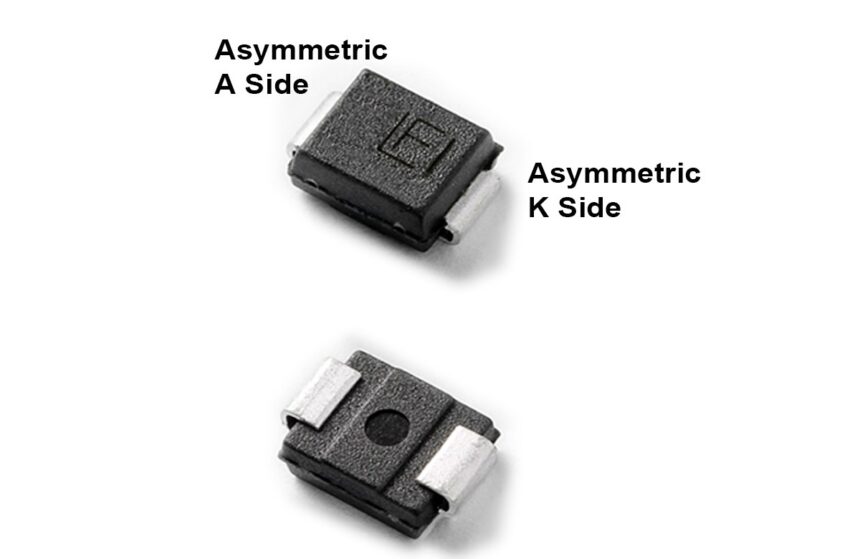
Littelfuse, an industrial technology manufacturing company, has launched the TPSMB Asymmetrical Series TVS Diodes: TPSMB2412CA, TPSMB2616CA, TPSMB2818CA, TPSMB3018CA. These devices have been designed by Littelfuse for 12V battery anti-reverse protection, providing advanced performance compared to traditional symmetrical bidirectional TVS solutions
The TPSMB Asymmetrical Series is a single-component solution that protects anti-reverse MOSFETs, diodes, and DC/DC converter ICs against both positive and negative surges. The asymmetrical clamping capability means negative surges will result in a lower clamping voltage, enabling engineers to select lower-rated MOSFETs or diodes, helping reduce conduction losses, simplify design, and decrease overall BOM costs.
Features and benefits:
- 600W peak pulse power, <1 ns response time, and up to 30kV ESD dissipation.
- DO-214AA surface-mount package to optimise board space.
- AEC-Q101 compliant with a -65°C to 175°C junction temperature range.
- Single device replaces multiple Zeners/TVS diodes, simplifying PCB design.
- Asymmetrical protection with low positive clamping and low negative clamping.
The TPSMB Asymmetrical Series is suitable for automotive applications requiring 12V battery anti-reverse protection, including:
- Domain and zonal controllers
- Body control modules
- Infotainment and lighting systems
- ECUs and power seats
- Motor pre-tensioner safety belts
- ADAS systems
Charlie Cai, director of product marketing at Littelfuse, said, “The TPSMB Asymmetrical Series delivers the industry’s first single-component solution specifically engineered for 12V battery anti-reverse protection. By enabling customers to use lower-voltage MOSFETs or diodes, these devices reduce conduction loss, simplify circuit design, and lower BOM cost while ensuring reliable automotive system protection.”
With the launch of the TPSMB Asymmetrical Series, Littelfuse expands its automotive protection portfolio to address the evolving requirements of 12V battery systems in modern vehicles.