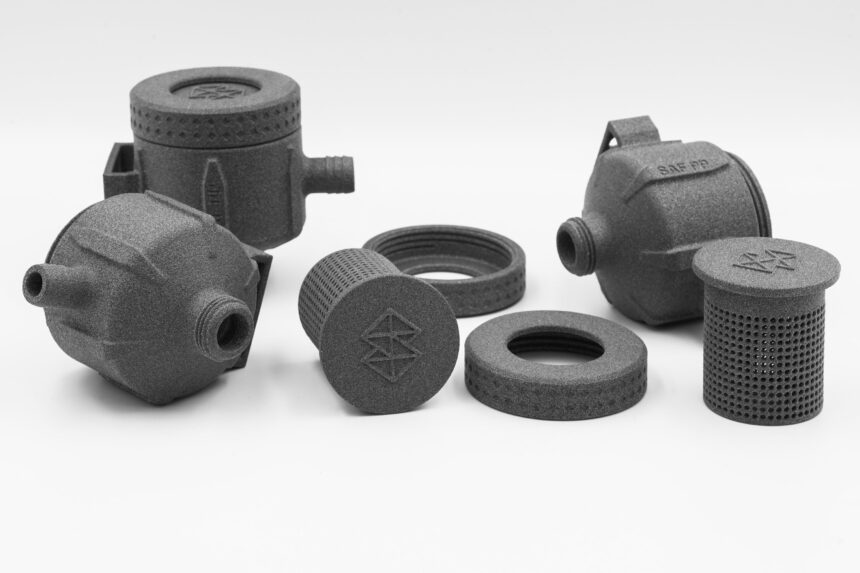
3D printing company Tri-Tech 3D has made selective absorption fusion (SAF) polypropylene available to its users. This enables high nesting density and allows for surface finish and dimensional accuracy. Applications include automotive and industrial machinery to orthotics and prosthetics industries.
Brett Turner, Stratasys sales specialist at Tri-Tech 3D said: “SAF PP is setting a new standard for polypropylene in powder bed fusion (PBF), offering unmatched resilience and flexibility compared with previous materials.”
SAF PP is designed to be used on the Stratasys H350 exclusively, which is a powder bed fusion (PBF) additive manufacturing (AM) system. This powers the delivery of production-grade polypropylene parts, which are applicable for high-volume demands.
Turned added: “The material’s thermal control and chemical stability is a real bonus. It improves part consistency, making it suitable for a wide range of prototyping and mass-production applications, including complex end-use parts — which can be challenging to produce.”
When used with the H350, SAF PP is consistent across large builds offering chemical resistance, watertight properties and being lightweight. Prototypes have shown consistent quality for research and development as well as functional end-part production during testing.
The material is best for printing smooth parts and end-use parts due to its high level of accuracy with uniform surface aesthetics and surface finishes. Large assemblies such as automation components are aided by the material's ability to be welded and joined by adhesion.
Turned said: “Supported applications range from ankle foot orthosis and foot inserts to automotive components like housings and ducting,” added Turner. “Being able to produce these components accurately and quickly and with a low cost per part is a game-changer, and SAF PP has strengthened our PBF offering no end.”