How new products including an industrial battery cell and an energy storage system could be a game changer for the industry
How new products including an industrial battery cell and an energy storage system could be a game changer for the industry.
In the ever-evolving realm of underwater technology, innovation is vital. Companies involved in the sector manage and build equipment structures located on, below, or buried in the seafloor. Lines include production risers, flow lines and associated production control systems.
One of the key players, SubCtech, is known for its innovation and both divisions of the company focus on new technologies but have quite different customer bases – the divisions comprise Ocean Power, dealing with subsea Li-Ion batteries and power equipment; and Ocean Monitoring, focusing on vessel underway equipment and ocean climate change analysis.
The ocean monitoring business unit
The Ocean Monitoring business unit makes up 10% of the company’s operations and supplies mainly to scientific institutes, research vessel-based scientists and ocean race sailors. The monitoring equipment covers surface and underwater greenhouse gas monitoring and micro-plastic samplers. The Autonomous Underway Measurement System (AUMS) is designed for pCO2 monitoring on ships (‘FerryBox’) and can be further upgraded via various available sensors: e.g. Meteo Top-Box for meteorological and sea-air exchange flux measurements and any third-party instrument.
The latest Microplastic Sampler, for example, enables monitoring on any type of sea vessel and can detect even the smallest presence of microplastics in the water, down to particles single parts per m3, without the need for large nets or complex filter systems. The next-level robust and waterproof design provides accurate sampling even on high-speed boats travelling at more than 30kn or underwater up to 3,000m water depth.
Ocean Power product division
The Ocean Power Products division makes up 90% of the company’s operations and supplies primarily to customers within energy sector, monitoring stations/moorings, subsea applications and autonomous underwater vehicles (AUV) as well as remotely operated vehicle (ROV) manufacturers. The Li-ion battery systems range from standard common off the shelf (COTS) subsea to customised vehicle batteries with and without battery-management systems (BMS) and chargers. The advanced-precision titanium housing is fully customised and can be designed for full ocean depth.
Subsea batteries for gas (LNG) production, for example, allow high-performance for a design life of 25 years with the electronics and Li-ion cells meeting specific and meticulous safety standards. In these cases, the rechargeable Li-ion batteries provide robust subsea uninterruptible power supplies (UPS). They are perfect for marine and offshore technology applications, offering next-level safety, reliability and availability.
The company’s PowerPacks automatically protect themselves via built in safety features. Some of the advantages of Li-ion batteries are the high current and standby operationality features, the ability to function at low to high temperatures and that they are able to cope with high currents/peaks. Furthermore, the corrosion-free titanium housings reduce OPEX costs down to almost zero and offer designs capable of operations in more than 6,000m depth.
According to SubCTech’s CEO Stefan Marx, the company’s Ocean Power unit offers both standard batteries and bespoke solutions: “We are able to offer solutions that fit our customers’ specifications and this is the service that has enabled our growth to date. Apart from advanced technology, trust from long-term relationships is key.”
Safety of Li-ion Batteries
Battery cells with SubCtech’s Li-ion technology offer huge advantages in terms of energy and power density in combination with safety, according to the company. However, all Li-ion or Li-pol cells are sensitive to overcharging, deep discharge and can be damaged by excessively high currents or temperatures. For safe operations and a long service life they need appropriate protection.
Their special industrial cells already have several built-in internal safety features: an overpressure valve, short-circuit protection, a steel housing and, in the case of the high-energy cells, a special temperature protection jacket around the electrodes. Although some of these properties may be found in ‘no-name cells’, only high-quality industrial cells offer the required failure rates of typically 1 in 10 million during their entire lifetime – the risk of failure according to FMEAs is extremely low.
The battery is primarily divided into safe battery modules. These can be scaled up and are monitored and controlled by a high-level controller battery-management system.
2 MWh record-breaking energy storage system (ESS)
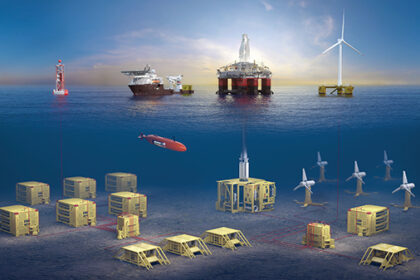
Many years ago, SubCtech recognised the ever-increasing demand for power and increasing capacity within the subsea sector for UPS, backup solutions or to support long tiebacks in brownfields. Its latest response is a new series of Li-ion batteries specifically aimed at large subsea energy storage facilities, vehicle propulsion and and the electrification of energy production locations.
The aim is to make global energy supply more reliable while also minimising production down time.
The resulting innovation is already making waves across the industry, according to the company. The Subsea 2 MWh Energy Storage System (ESS), is fully qualified according to API17F and is already reaching TRL 6. The storage system is now being deployed underwater for operational use.