
Leveraging shallow water expertise to drive low-carbon well intervention
Aquaterra Energy, a UK-headquartered offshore engineering specialist, marked its 20th anniversary this year. Over the past two decades, the company has evolved from a niche provider to an international leader in shallow-water engineering, risers and well intervention
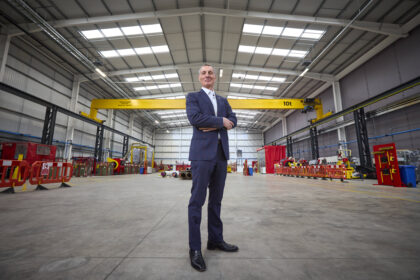
“We were founded in 2005, and this year we celebrated our 20th anniversary,” says Anne Haase, strategy and commercial director at Aquaterra Energy. “We’ve always focused on shallow-water specialisations. Over the last 20 years, we’ve expanded into well intervention, completions, risers and wellhead platforms – specifically for shallow-water environments.”
With 120 employees and £30 million turnover, Aquaterra Energy exports 90% of its services overseas. “We’re a truly international business,” Haase explains. “Our skills are being exported all around the world, and that’s something we’re really proud of.”
BRIDGING OIL AND GAS WITH THE ENERGY TRANSITION
Haase oversees the “front end” of Aquaterra’s operations, covering both the oil and gas and the energy transition. She notes a significant cultural shift in recent years: “Having done this for 25 years, I’ve seen a less adversarial approach over the last five years and less competition between sectors. These industries are increasingly complementary, and there’s a more balanced approach to transition, which I think we will continue to see.”
Key to that approach is carbon capture and storage (CCS) and gas storage, where Aquaterra’s skills can support both decarbonisation and energy security. “CCS is absolutely fundamental for decarbonisation in Western economies,” Haase says. “It’s about using our skills not just for the energy transition but also for energy security, and leveraging UK assets effectively.”
UNLOCKING SHUT-IN WELLS
Well intervention is central to Aquaterra’s current work. “Shut-in wells are essentially closed off because they’re not economically viable at a particular time,” Haase explains. “Around 30% of wells on the UK continental shelf are currently shut in, particularly in the southern North Sea.”
According to Haase, the North Sea Transition Authority recognises well intervention as a core enabler for low-carbon production: “We believe integration is key to accessing cheap oil and gas produced mindfully. At £12-15 per barrel of oil equivalent in uplift costs, the UK could become far more competitive compared to Nigeria at $48 or the Middle East at $15.”
STABLE, SUSTAINABLE INTERVENTION
Aquaterra also advocates for jack-up rigs in shallow waters instead of dynamically positioned (DP) vessels. “DP vessels are fantastic for deep water,” Haase says. “But in shallow water, the movement can risk hydrocarbon release or infrastructure damage. Jack-ups are stable, creating a tripod-based platform to safely intervene in older infrastructure.”
This approach is supported by advanced riser and pressure-control technologies, which Aquaterra engineers to reduce risk. “These systems have to be highly designed and engineered to handle high pressures and temperatures,” Haase says. “They form part of the primary well-control envelope, reducing hydrocarbon release risks and improving safety.”
FUTURE OUTLOOK
Haase sees opportunities in new shallow-water markets like the Middle East and Nigeria alongside CCS, and believes that the 2030 net-zero goals will require realism and collaboration. “We all need to develop a sense of balance and a common commitment to move toward the transition with our eyes open as we phase out oil and gas for the things it should never have been used for,” she says. “Oil is far too precious to be used for single-use plastics. It has its place, but we must use it wisely.”