
Seeing further
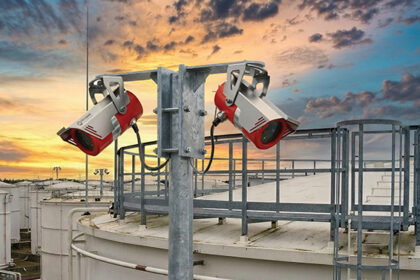
Fire and gas system design has always been bounded by one quiet assumption: how far each flame detector can reliably see. For most of the past two decades, certified detection range for IR3 flame detectors has sat at 30m in standard sensitivity and 60m in high sensitivity
Those numbers have shaped every fire and gas layout drawing produced for oil and gas, petrochemical, and LNG facilities in that time. With certified detection range now extending to 160m, the obvious question is what that actually changes in practice, and just as importantly, what it does not.
ASSESSING THE CHANGES
Credible fire and gas mapping is not a matter of dividing the plant area by the detector coverage cone. A properly graded assessment works from the detector’s effective viewing distance, denoted D, which is derived from the certified test distance to a one square foot n-heptane reference fire and adjusted for desensitising factors such as false alarm stimuli and optics contamination. Performance requirements are expressed as multiples of D. A typical blanket-graded hydrocarbon risk area specifies alarm coverage of every point by at least one detector within 1D, and voted control coverage of every point by at least two detectors within 2D. The 1D requirement catches the reference-size fire at the design range. The 2D requirement, twice that distance, reflects the inverse square law (a larger, more developed fire is visible from further away) and the need for voted redundancy before automatic control actions such as emergency shutdown or deluge release will initiate. Combined with cone-of-vision geometry, line-of-sight obstructions, and detector failure tolerance, this is what drives detector count on any real layout.
MODELLING THE RESULTS
To quantify the effect in a realistic setting, an onshore plant area of 160m by 75m, 12,000sqm in total, was modelled using HazMap3D with a standard hydrocarbon risk basis. The area was assessed three times against the same blanket-graded coverage requirement, with the only variable being the detector’s effective viewing distance. The detector, the voting logic, the grade, and the 3D site geometry were held constant across the three scenarios.
At the standard 30m setting, the assessment required 21 flame detectors to satisfy both the 1D alarm coverage at 30m and the 2D voted control coverage at 60m. Stepping up to 60m high sensitivity mode reduced that figure to 10 detectors, a 52% reduction. Applying the 160m range profile brought the count down to 6 detectors, a 71% reduction against the standard configuration and a 40% reduction against the high sensitivity layout. On a site of this scale, that is a meaningful efficiency gain, but the numbers also tell a more nuanced story than a simple range-squared relationship would suggest.
The interesting observation is what happens between 60m and 160m. Coverage cone area scales with the square of range, so in theory a 160m detector covers roughly seven times the area of a 60m unit. If detector count reduced in proportion, the 160m layout would fall to one or two detectors. It does not. On a bounded site of finite dimensions, detection range stops being the limiting factor once D exceeds the longest diagonal from any candidate mounting position. At 160m, a single well-positioned detector can satisfy the 1D alarm requirement across the entire 160m by 75m plant, and the 2D voted control requirement at 320m is trivially met. But the design still needs multiple detectors to satisfy voting redundancy, to close out corners and obstructed volumes, and to tolerate the failure of any single unit. Once range exceeds the site envelope, the binding constraints shift from viewing distance to voting logic, cone-of-vision geometry, and redundancy. The reduction curve flattens accordingly.
EVALUATING THE DESIGN IMPLICATIONS
For a fire and gas engineer, the practical consequences are clear. Extended range delivers its greatest benefit on larger open-area sites where range sets the detector count. On smaller or heavily compartmentalised areas, the gains are more modest, because voting and line-of-sight constraints become binding well before range does. The design implication is that detection range should be selected zone by zone rather than applied uniformly across a facility. Even so, a 40% reduction over high sensitivity mode translates into fewer cable runs, fewer junction boxes, reduced inspection and maintenance burden, and lower through-life operating cost. On brownfield sites where IR3 detectors are already installed, a firmware upgrade path enables extended range without any hardware replacement, and an updated 3D mapping assessment can identify detectors that may be deactivated or repositioned while maintaining the original safety case.
Extended detection range is not a licence to strip out detectors indiscriminately. It is an additional tool in the fire and gas designer’s kit that, applied to the right geometries, delivers measurable reductions in installed and operating cost without compromising the safety integrity basis. The numbers, drawn from a realistic site assessment rather than a marketing abstraction, make the case on their own.
Ben Rafferty is head of consulting services at Micropack Engineering. www.micropacksafety.com